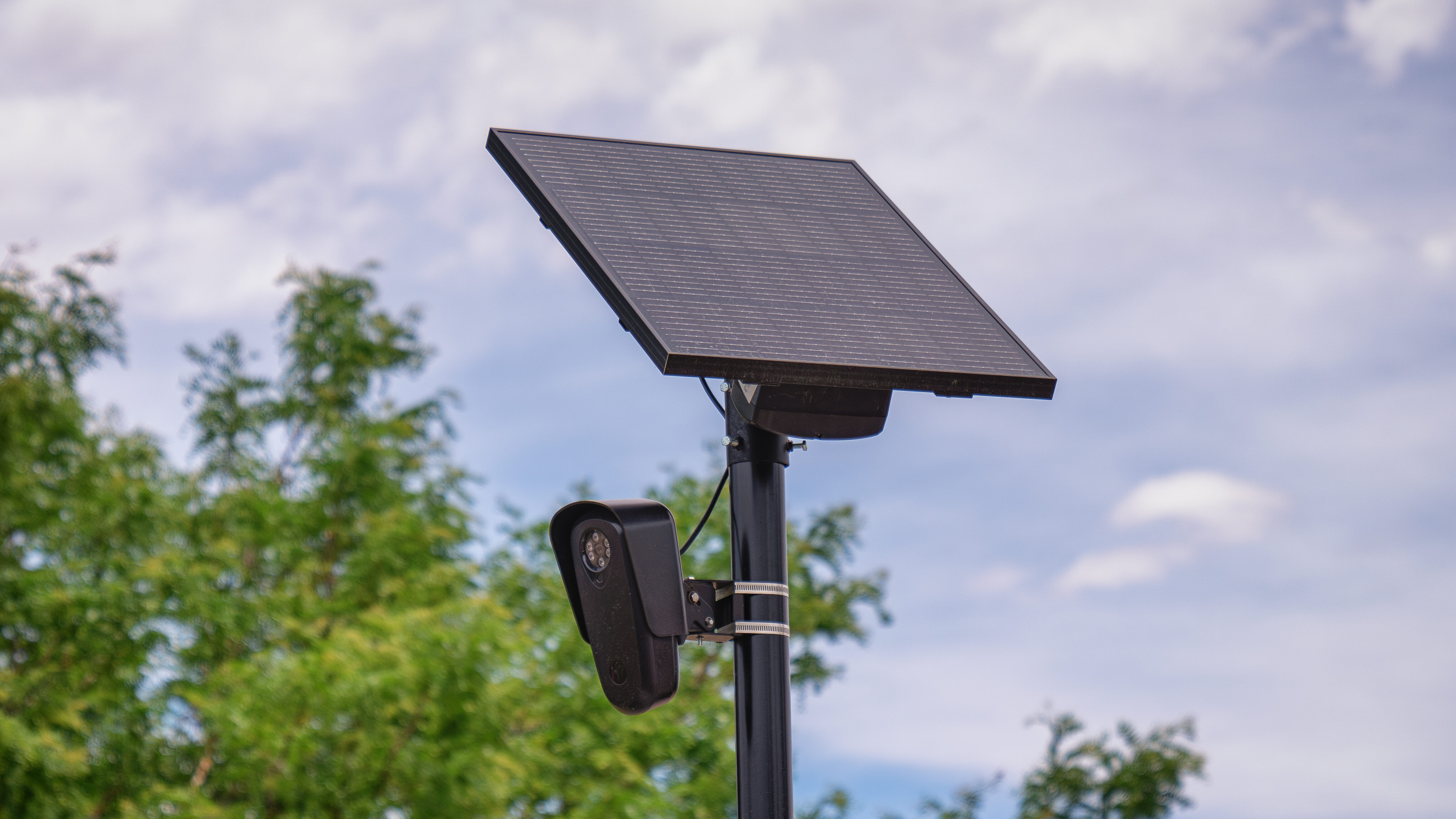
As federal immigration enforcement has intensified, local police departments’ usage of surveillance technology has been increasingly scrutinized. Flock Safety’s Automated License Plate Readers (ALPRs), used by both the East Palo Alto (EPA) and Atherton Police Departments, have emerged as a main target.
Flock was created in 2017 and has quickly come to dominate the ALPR market. ALPRs use optical recognition technology to analyze video from cameras in public areas and compare footage to license plate numbers of vehicles associated with a crime or suspect. Police and investigators are then notified when vehicles of interest are spotted. Atherton currently has 53 cameras, and EPA has 25.
The cameras have sparked controversy nationwide, as cases of the technology allegedly being used for stalking, harassment, and immigration enforcement have gained national attention. Given Immigration and Customs Enforcement (ICE) activity in EPA in the past seven months, many have questioned whether these cameras could be misused for immigration enforcement purposes locally.
Flock explicitly states on their website that ICE does not have direct access to the data. However, 404 Media reported that, as of May 2025, upward of 4,000 searches had been conducted at the request of the federal government nationally, with the purpose of “immigration.”
Furthermore, the city of Mountain View announced that federal agencies—unrelated to immigration enforcement—accessed the city’s Flock databases in 2024. According to Mountain View, this incident occurred because Flock enabled a “nationwide” search setting without the city’s consent or knowledge.
Since this incident, Flock’s “systems have been improved and that they no longer enable any access sharing outside of the State of California,” according to a statement released by the city of Mountain View.
“Our community has a very large immigrant community, and that is a concern,” EPA City Council Member Ruben Abrica told the M-A Chronicle. “And I would guess, if you go ask immigrant communities, ‘What do you think about this, and the possibility that they might get the information on you?’ I think people say, ‘No, I don’t want it to, I hope they don’t.’”
Flock is one of the most widely used license plate reading systems across the U.S., with cameras being deployed in over 5,000 communities. Unlike its major competitors, however, Flock has refused independent security review. An independent security review is a third-party assessment of an organization’s security measures that tests the validity of the claims made.
The EPA Police Department has implemented safeguards to prevent federal agencies from accessing the data. After 30 days, the data is discarded. Also, according to Chief of Police Jeff Liu, the data is continuously audited to ensure it is not being accessed by unauthorized departments. If the data is accessed by anyone unauthorized, the city’s contract with Flock can be broken.
In December 2025, the EPA City Council voted 3-2 to extend their contract with Flock for another five years in a $453,250 deal.
“Right now, we’ve had lots of good results and safety and security,” said EPA City Council member Mark Dinan, who voted to continue the city’s partnership with Flock. “People deserve to live in a safe and secure community, and we need to empower our police officers with the modern technology that enables them to do that.”
Abrica, who voted against the measure, disagreed. “This federal government is using every tool at their disposal, including technology, to go after not only immigrants,” he said.
The EPA Police Department publishes monthly reports of Flock’s successes, and has reported the technology to be very effective in both catching perpetrators and deterring crime. In the past year, Flock ALPRs have been used 84 times to assist with investigations.
However, some have argued that the benefits of this technology have been overstated. “Anytime you make claims like cause and effect, you have to be very careful to ascribe the cause, that ‘If we hadn’t had the cameras, we wouldn’t have been able to solve this.’ Logically, that’s not a good argument,” Abrica explained.
Others questioned the legitimacy of fears over this technology being used for immigration enforcement altogether. “It’s the wrong tool for any sort of immigration enforcement,” Dinan said. “If you look at what’s going on in Minnesota or what’s happened in Chicago, they’re not messing around with tracking individual people. The idea that they would have to use Flock cameras to come in and harass immigrants is nonsense.”
However, ICE has conducted targeted operations in EPA in the past seven months.
“[Community members] just don’t trust our federal government, and they don’t trust that Flock won’t be subject to a data breach at some point, where somebody will forcefully take the data out,” Liu said. “There’s a lot of fears floating throughout the United States right now, and it’s really sad to see. And I can’t say that those fears are not real, there have been plenty of times over the last year that’s like, ‘Oh no, that’ll never happen.’ And then it happens.’”
“To me, it’s like, why give them another tool? Why? Somebody’s already beating you over the head. And so why say, ‘Here’s another hammer?’” Abrica said.