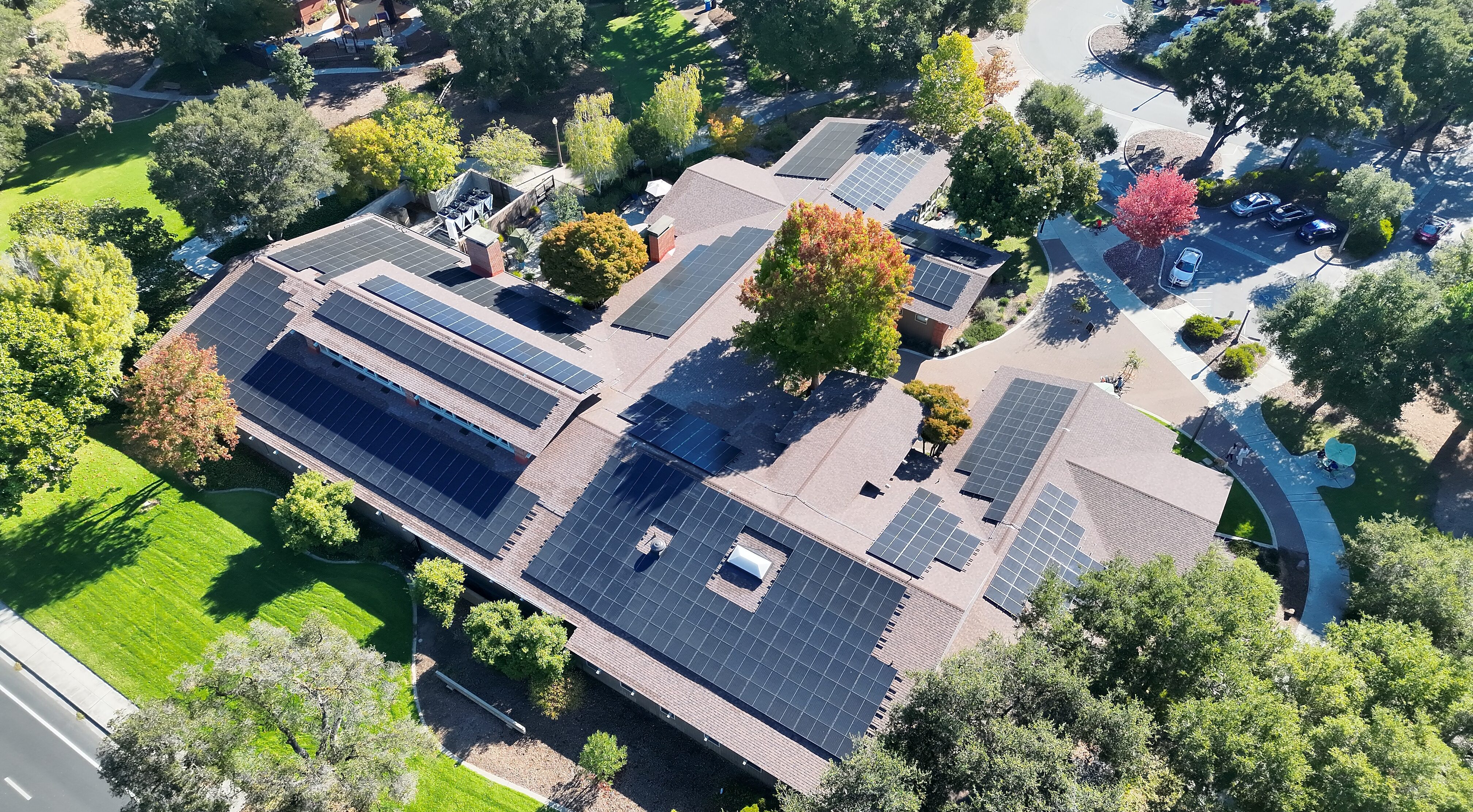
Menlo Park has installed solar panels on four city buildings as part of its 2030 Climate Action Plan. The project reflects the city’s shift away from methane gas and toward all-electric systems in an effort to reduce fossil fuel emissions and move toward a more climate-focused future.
The Menlo Park Library has become a visible symbol of this transition. “The inclusion of the Menlo Park Library building in the City’s ongoing renewable energy efforts represents an acknowledgement that the Library is intrinsic to the health of the City,” library supervisor Rose Waldman said.
The city is installing the panels through a partnership with Peninsula Clean Energy (PCE), which offers power purchase agreements with municipalities. Under this model, there is no upfront construction cost for the city. Instead, PCE manages the design, permitting, and installation. The city purchases solar electricity generated through a Power Purchase Agreement with the PCE at a fixed rate significantly lower than current grid electricity costs. The financial impact overall is estimated at $3.2 million in savings over 20 years, with City Hall alone projected to save about $74,000 per year.
Facilities that participate in the program are selected through a set of criteria, including the remaining useful life of the roofs and the photovoltaic (PV) system size based on typical electricity usage.
Right now, Menlo Park has installed solar panels on four city facilities: the Belle Haven Child Development Center, Burgess Pool, City Hall, and the Menlo Park Library.
This project is one of the largest solar expansions on municipal buildings in Menlo Park. Altogether, these four systems are projected to generate over one million kilowatt-hours of electricity annually, covering most or all of the energy needs for the city buildings. The panels can cover nearly all electricity use at City Hall (97%) and the library (92.5%). The Belle Haven Child Development Center can produce more electricity than it uses (126%), while Burgess Pool’s panels are projected to supply about half of its power (52%).
“Solar installations are a great complement to electrification,” Sustainability Manager Rachael Londer said. Once buildings switch to electric systems, these solar sites can lower costs and reduce emissions.
The timing for the city to participate in PCE has been shaped by state policy. It had to move quickly to qualify for better solar payment rates before new rules (NEM 3.0) took effect, with a final deadline of April 14, 2026 to have the systems installed and energized.
The installations are also meant to send a broader message to residents. “When residents see solar on their public buildings, it signals that clean energy is practical, cost-effective, and already here,” Londer said. Because PCE provides completely clean electricity, both grid electricity and on-site solar can be emissions-free, which means the added benefits of on-site solar are more stable electricity prices, producing energy locally, and improving the buildings’ ability to keep running during power outages.
Looking ahead, officials say the project is only one step in a broader transition toward renewable energy in Menlo Park. “Member of Peninsula Clean Energy, a $4.5 million state grant for home electrification, updated building codes, city fleet electrification, and a long-term commitment to carbon neutrality by 2030 are all moving simultaneously. This solar installation is an important, visible milestone in a comprehensive effort to transition Menlo Park to clean energy,” Londer said.
The city is also exploring battery storage systems and programs to help residents electrify their homes. For example, the Belle Haven Community Campus microgrid, which connects solar panels, solar thermal systems, and battery storage, is expected to be completed once the city finalizes a new solar installation at Kelly Field, expanding its ability to operate during outages.