

When Congress passed Section 504, it aimed to make education more accessible for individuals with disabilities. And in many ways, it did, creating accommodations such as extra time, separate testing settings, and access to typing for assignments and exams. Yet, the law’s complexity and the absence of federal funding have forged socioeconomic and racial disparities in students’ ability to access its accommodations.
Section 504 acts as a safety net for students who don’t meet rigid Individualized Education Program (IEP) criteria. However, compared to IEP criteria, Section 504 is vague in both its definition of disability and its suggested accommodations. Moreover, a lack of specific application guidelines makes the law incredibly difficult for schools, students, and families to interpret and implement.
Despite being legally mandated to identify and evaluate students who need 504 plans, many schools either fail to do so or face a significant backlog. Instead, families who can afford to do so hire private psychologists for an evaluation, creating an inherent reliance on wealth and education to access support.
Now, 504 implementation is expanding nationwide. Since 2018, M-A has seen a 59.4% increase in the number of enrolled students with 504s, even as enrollment has declined by 13% in that same period. But this process is happening disproportionately, turning a tool designed to improve educational equality into an exclusive service.
To prevent marginalized students from being excluded from 504 services, the law must be restructured to include stricter guidelines for schools and to provide funding for accommodations and timely evaluations.
IEPs vs. 504s
California schools are required to provide educational services that satisfy students’ needs at no cost to families—a guarantee that holds far more firmly for IEPs than for 504s.
An IEP plan, regulated under the Individuals with Disabilities Education Act (IDEA), provides families with clear instructions on the evaluation process and implements accommodations for their child at no personal expense. Once a student is found eligible for one of the 13 approved disabilities, they are permitted to receive specific interventions in the school curriculum, such as assistive technology or occupational therapy. Federal law affords families the right to request a private Independent Educational Evaluation (IEE), which schools must pay for if a family deems the school’s IEP evaluation inadequate for their student’s needs.
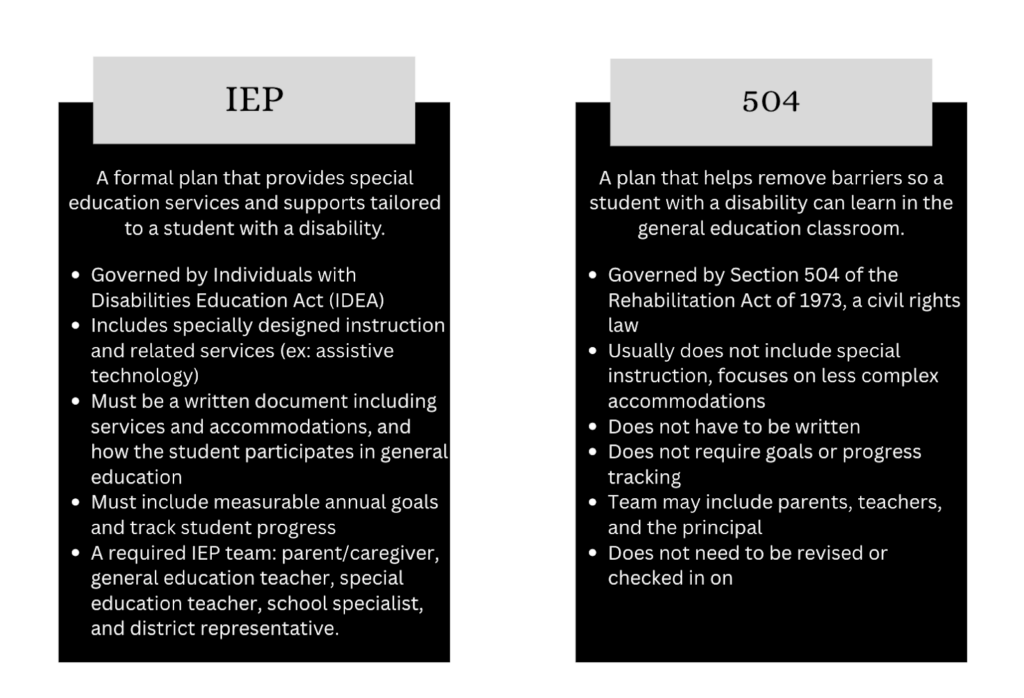
Section 504, however, lacks this coherence and organization. Passed under the Rehabilitation Act of 1973 and enforced as a civil rights law, Section 504 addresses physical and mental impairments not listed under IDEA that affect school performance. According to neuropsychologist Karen Dearing, 504s cover mild to moderate impairments, ranging from ADHD and dysgraphia to anxiety and depression, and even to concussions, gender dysphoria, and temporary injuries. No written plan is required of the school when creating accommodations for a student.
“504 is so broad that it would be hard to think about [accommodations] that work for a two-year-old with spina bifida that also work for a 75-year-old who’s still working at a hospital and has a visual impairment,” Meghan Burke, a professor of Special Education at Vanderbilt University, said.
504s are ambiguous in both their requirements and accommodations. “[The plans] don’t tend to list why a student is getting a certain accommodation, or any type of evaluation data that’s been used to determine that they qualify for 504,” Burke explained. “It doesn’t even tell you necessarily who’s at the meeting to develop the accommodations.”
“504 is so broad that it would be hard to think about [accommodations] that work for a two-year-old with spina bifida that also work for a 75-year-old who’s still working at a hospital and has a visual impairment” – Vanderbilt University professor Meghan Burke
504s and IEPs are funded differently because they fall under different federal laws. Schools are required to cover the full cost of IEPs, including any diagnostic testing, specialized instruction, and services, through federal, state, and local funding. Conversely, 504s do not have a separate stream of funding because they are part of a civil rights law. While families can file an Office for Civil Rights complaint if a school fails to properly evaluate a student, there is no guarantee they will receive a compensatory service.
Private Diagnoses vs. School Diagnoses
Section 504 requires all educational entities that receive federal funding to actively seek out students who meet 504 disability requirements and evaluate them for a plan—a responsibility known as “Child Find” duty.
“In theory, accommodations should be available to students regardless of where they go to school. It certainly should be fairly consistent across public schools because public schools are all governed by the same federal education law. In practice, that’s not always the case,” Dearing said.
M-A’s 504 coordinators receive their funding from the District’s general fund, which has faced recent pressures due to declining enrollment, leading to significant cost-cutting measures, such as the closure of TIDE Academy. The department also relies on donations from the school’s Parent Teacher Association, according to the coordinators.
Even beyond funding discrepancies, private and school psychologists evaluate students for 504s differently. The vast majority of private psychologists use the Diagnostic and Statistical Manual of Mental Disorders (DSM-5) diagnostic criteria, along with cognitive testing and other holistic measures, to produce comprehensive evaluations, diagnoses, and accommodation recommendations.
The approach allows for far greater flexibility and speed in identifying a cause for diagnosis. According to Dearing, even if a student doesn’t clearly present learning disabilities through standardized testing, if student, parent, and teacher testimonies suggest otherwise, she will likely still recommend accommodations.
On average, private evaluations often cost anywhere between $3,000 and $7,000.
Conversely, public school psychologists are solely guided by Section 504’s definition of disability, which offers limited guidance on how to diagnose students. The evaluation requirements rely on appropriate diagnostic tests and a loosely defined team of “knowledgeable” individuals to create the plan, leaving significant room for interpretation.
On average, private evaluations often cost anywhere between $3,000 and $7,000.
“The functional barrier there is that public schools are limited by their resources and the time and the money that they have available to them,” Dearing said. “In my opinion, where IDEA and DSM diverge a bit is where you draw the line when it comes to mild, mild to moderate, versus moderate to severe learning and processing disabilities […] DSM is generally a little bit more flexible.”
A diagnosis from a private psychologist rarely receives pushback from schools, which are legally obligated to cover the cost of an additional evaluation if they refute it. “When you come into a 504 meeting with an external diagnosis, that’s the best irrefutable evidence,” said Zachary Rossetti, an associate professor of special education at Boston University.
Rather, when students come to a school for an evaluation, obtaining accommodations can take months to years. At M-A, Sam Leslie ’24 struggled with illegible handwriting for three years before he finally received a 504 plan from the school. Until halfway through his junior year, Leslie would come in after class and retype his handwritten essays and classwork for teachers to read. Though previous teachers had suggested that he seek a dysgraphia diagnosis from a private psychologist, Leslie, like many students, wanted to avoid the thousands of dollars necessary for a private diagnosis.
“When you come into a 504 meeting with an external diagnosis, that’s the best irrefutable evidence” – Boston University associate professor Zachary Rossetti
That was until Leslie’s junior year, when his English and history teachers suggested he email former 504 Coordinator Jennifer Hettel to be evaluated. Leslie’s teachers submitted an evaluation request in January 2023 after compiling writing samples from Leslie. He wasn’t evaluated until May 2023 and received minimal communication from Hettel in the interim.
“They weren’t super responsive,” Leslie said. “She seemed to have a really insane load with not enough support.” Today, not much has changed. Only two 504 coordinators support 338 students with accommodations on campus.
Even after being evaluated in May—a process that he said lasted 15 minutes—the College Board did not approve Leslie’s accommodations in time for his AP exams.
Leslie noted that he likely wouldn’t have been evaluated without his English teacher’s advocacy. Still, his prolonged wait and haphazard evaluation are fairly standard across most school evaluation processes. “[Section 504] says ‘reasonable amount of time,’ which is subjective,” Burke said.
Though many students, like Leslie, hope to attain a school evaluation to avoid the costs of a private diagnosis, the lack of communication and clarity from schools can deter many. Senior Ruby Stone struggled with reading and writing throughout middle school and initially intended to pursue a school evaluation rather than pay for a private diagnosis in the summer of 2021.
After being repeatedly denied for a school evaluation in both sixth and seventh grade, Stone’s learning difficulties only worsened.
“The cost became worth it because I just needed my diagnosis, so they weren’t going to keep denying me. I just had to do it,” she said. “They didn’t consider me at risk because I still got decent grades, but it very obviously took me a lot more effort to get to the same place as people around me.”
Though Stone eventually received her private diagnosis and accommodations in late 2021, the price of such support was not lost on Stone and her family. “[My mom] always jokes about how it was so expensive compared to how the school could have done it,” she explained.
504 by The Numbers
In recent years, the number of students using 504s has grown significantly, in part due to the Americans with Disabilities Act Amendments Act of 2008. This legislation broadened how disability is interpreted, making it easier for students with mental and physical impairments to qualify for accommodations.
Nationwide, as enrollment decreased due to a declining birthrate, the number of students with 504s grew by about 300,000 between the 2017-18 and 2020-21 school years. Since District data collection began in 2018, the number of enrolled M-A students with 504s has increased by 59.4%, even as overall enrollment has steadily decreased.
According to Dearing, this trend is to be expected. The expansion of the law, in addition to the ongoing mental health crisis and growing disability awareness, has enabled a large increase in the number of students utilizing 504s.
However, this growth has happened inequitably, dominated disproportionately by wealthy, educated, and white families. These trends have emerged nationally, but are especially prominent at M-A.
Sixty-nine percent of students with 504s attended Hillview Middle School or La Entrada Middle School—both of which have predominantly white student bodies and draw from some of the wealthiest neighborhoods in the nation. Meanwhile, students who attended the East Palo Alto-based Ravenswood School District make up only 7% of students with 504s. Students’ feeder middle schools often reflect racial, socioeconomic, and educational divisions as a result of intense historical redlining and gentrification within San Mateo County.
Of all M-A students with 504s in the 2025-26 school year, only 42% of them identify as students of color. However, students of color make up 68% of M-A’s total population, highlighting a 26-percentage-point gap between the two groups.
Conversely, while white students make up only 32% of this year’s student body, they account for 58% of all students with 504s.
The racial discrepancies also reflect a much more disturbing chasm among both parental wealth and educational background. Of all M-A students, only 52% have a parent with a bachelor’s degree or higher. However, that same population comprises 75% of students with 504s.
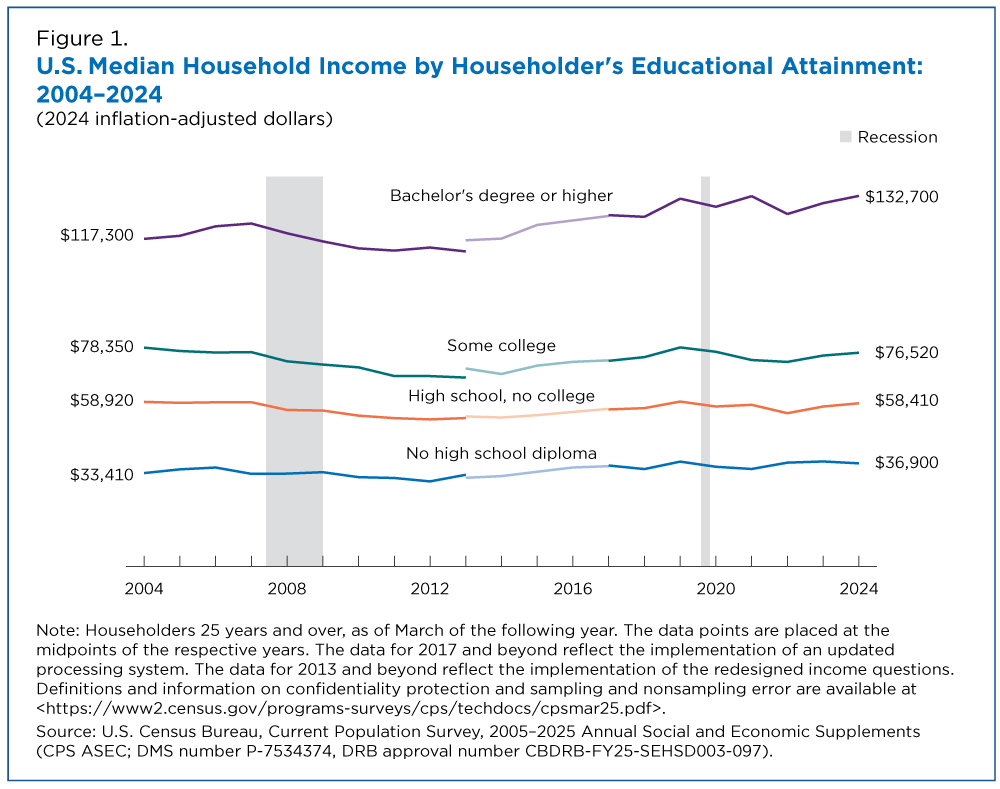
College completion is closely tied to socioeconomic status. Households headed by someone with a bachelor’s degree or higher have a median income that is $74,290 greater than households headed by someone with only a high school diploma. When advocating for 504 access, parental education and literacy offer significant advantages in interpreting Section 504 and IDEA, which were written at a 16th-grade reading level, according to Burke.
Even for highly educated parents, the vagueness of Section 504 is nearly impossible to decipher, which is why those who can afford to often turn to private specialists to navigate the law for them. As a result of their wealth, these educated households essentially cut to the front of the line. This dynamic not only creates unequal use of the system but can embolden families to pursue accommodations that go beyond pure necessity, garnering additional time and support on consequential exams like the SAT and ACT.
“I would say, almost without exception, that these laws are difficult to navigate, even if you’re really well educated, even if you have a really high socioeconomic status,” Burke said. “It’s hard to gain the knowledge that you need to be able to advocate for services.”
“[504s are] kind of becoming something you can just pay for. And that’s unfortunate, because there are people who do need them, but there are a lot of people who think of it as a tool you can just pay for,” Stone added.
As a result, only 59 of 338 students with 504s are socioeconomically disadvantaged.
Reform and Solutions
The racial, educational, and socioeconomic discrepancies among students with 504s are not just alarming—they are discriminatory.
The vast majority of students with 504 needs who aren’t in dire circumstances wait for months or years to be evaluated. Their grades aren’t poor enough to raise alarm, and their parents aren’t interested in burning thousands of dollars on a private evaluation, so they sit, and wait, and nothing comes.
“Students who need accommodations, and probably need a 504 plan but aren’t getting them, fall through the cracks. I’m sure the majority of them are getting worse grades than they would otherwise and are having a tougher time getting into college than they would otherwise,” Rossetti said.
Without designated federal funding for 504 services, districts must draw on their general budgets and donations, neither of which can satisfy the growing demand. To evaluate these students, schools need more psychologists and more comprehensive accommodation services. In other words, schools need money.
To increase access for marginalized students, Congress must amend Section 504 to include per-student provisions that support evaluation and accommodation costs. To centralize the process and eliminate ambiguity, Congress should require schools to use a standardized, written template that thoroughly details necessary accommodations and how they will be implemented.
Additionally, the law must require the involvement of parents/guardians, academic counselors, school psychologists, and at least one core subject teacher in the evaluation process. Once administered, schools should continue to play an active role in the student’s education, regularly checking in to ensure their accommodations are sufficient. “When families are involved in your education, your academic outcomes also improve, and this is true for students with IEPs or 504 plans and [students] without disabilities,” Rossetti explained.
Ultimately, implementing Section 504 is inherently challenging. Supporting students with such diverse needs is not easy. But it is not impossible.
To ensure equal access for all students, it is imperative that Section 504 be revised to include clearer guidelines and funding. Ignoring such reforms will turn the law into a tool for educational discrimination and render its civil rights capabilities useless.
Gaby Foster and Isabel Habibi were the lead authors of this article.

great article. anyone who has been in an ap class at ma recognizes the kayfabe involved with 504s and their function as a license to effectively cheat on exams. a symptom of gamified and economically stratified college admissions. will never forget overhearing “why do all the white kids have 504s” lmao