5/10
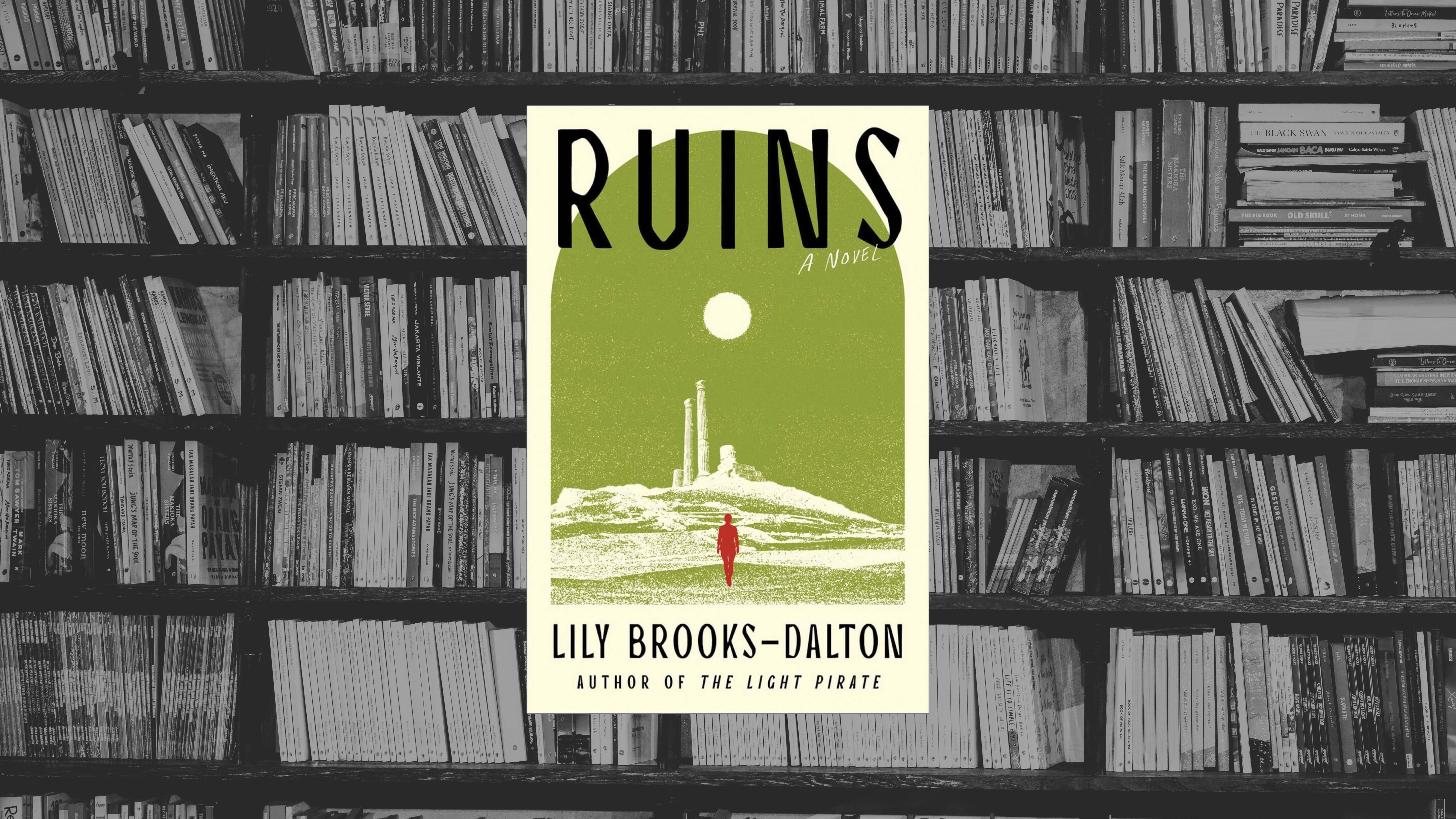
Lily Brooks-Dalton built a reputation for quietly reflective climate fiction with The Light Pirate, a story that blends an environmental collapse with intimate, character-driven storytelling. Despite similar intentions, Ruins falls short. Set in a future shaped by environmental collapse, the novel explores isolation and control within a tightly regulated society—but never fully brings those ideas together. The novel is choppy and disjointed, jumping between perspectives, making it difficult to get invested.
Ruins is certainly a page-turner. Brooks-Dalton’s writing style and voice have developed beautifully as she continues to publish novels, and the book’s premise is compelling in theory. However, there are several faults in its execution. The novel’s disconnected three-part structure and the frustratingly unlikable protagonist made this a difficult read.
The novel follows Ember Agni, a once-promising archeologist turned bitter academic, in a slightly dystopian future society called the Commonwealth. This community was built following a global climate catastrophe known as the Crisis. Ember lives in a city near the North Pole, but snow is rare. The city runs on hydroelectric power, has no computers, cars, or air travel, and while ships fill the harbor, ocean voyages are extremely dangerous.
The story picks up with Ember working as a professor at a university, a job that bores and frustrates her, as she would much prefer to work in the field. Ember is widely hated among students and faculty for being rude, selfish, and extremely narcissistic—willing to sacrifice every relationship she has ever had for her passion for archeology. That passion, an obsession with an artifact from Pre-Crisis time, challenges their current understanding of history.
She first sends one of her students to the mysterious Continent, the land mass where the civilization was located before the Crisis, in search of the artifact. Still, after the student sends her the artifact, she decides she must follow him to the Continent to further explore historical truth.
The second section of the novel follows a trial that pits Ember against her university peers, government representatives, and the Commonwealth entirely. Although the proceedings are meant to discredit Ember, they instead grant her permission to lead a group to the Continent to investigate the artifacts’ origins. As the expedition finally becomes reality, Ember is forced to face the consequences of her obsession. She must grapple with the loneliness she has created by leaving her husband and expose the lies buried beneath the ruins of the Continent left by the Commonwealth.
Ember’s character is the book’s biggest obstacle to success. She is written as a flawed, headstrong woman, but those flaws too often cross over to selfishness in ways that feel more frustratingly destructive than compelling. Starting with a deeply flawed character can set up a strong character arc, but Ember refuses to change or act in any way that does not solely benefit herself, making her difficult to grow attached to.
Her actions don’t just complicate situations, they create them when there is no need for them. Many moments that could have built suspense or tension through external conflict instead feel driven by avoidable choices, making it nearly impossible to sympathize with her struggles.
Brooks-Dalton’s prose remains one of the novel’s strengths. The writing is controlled and strategic, subtly foreshadowing the twists and turns of Ember’s adventure. Brooks-Dalton expertly develops the world through the lens of an archaeologist, uncovering clues in the structures around them and slowly unraveling the journey alongside the protagonist.
The biggest problem with Ruins is that it doesn’t quite seem to know what kind of story it wants to tell. At times, it reads like an intimate self-discovery and survival story. At others, it leans into a fragmented, almost poetic social commentary on government propaganda. Neither approach is inherently bad, but the constant shift between the two creates an identity crisis from page to page, dragging the entire book down.
Instead of blending these styles, Ruins continuously pulls itself in different directions. As soon as you settle into the present-day survival plot, the story jumps back into a memory or loosely connected sub-plot. If the sections worked seamlessly together, it could be a fascinating mystery, but it ultimately reads as disconnected and choppy.
And yes, the novel’s atmosphere is well developed. The slow erosion of normal life, the quiet dread as Ember uncovers the past, it’s all effective, but the character-driven story can only be as compelling as the central character. Ember’s egocentric actions consistently undermine the plot. It’s difficult to appreciate the key conflicts as inevitable consequences of the deteriorating world when it feels like the protagonist is creating all these problems out of nothing.
Too much of the book is spent on underdeveloped relationships and backstory, as well as in Ember’s thoughts, debating right and wrong and the ongoing personal justifications of her poor choices and repulsive behaviors. This is not to say the book lacks anything good. The imagery is certainly striking, and the sense of dread and isolation feels genuine. But these moments are too few and far between to make this a truly enjoyable read.
Ruins has the bones to be a powerful story, but never builds enough around them to make it fully stand. It reaches for something meaningful, but gets lost trying to prove it has something to say.