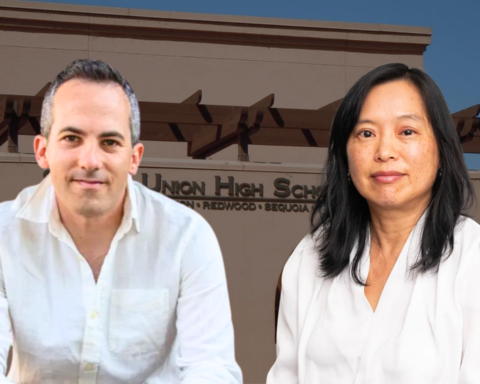
The District Board of Trustees reached a contract agreement with the Sequoia District Teachers Association (SDTA) regarding a salary and stipend increase for all employees at the Oct. 7 Board meeting. This wage raise is reflective of the growing cost of living in the area and, according to the SDTA bargaining team, aims to outpace current inflation rates.
The agreement features a 5% salary raise, a step up from last year’s 3% increase. This increase applies to annual salaries as well as additional hours, like professional development and training.
The increase also applies to any stipends that employees earn. “Department chairs, coaches, and people who supervise certain activities get stipends,” SDTA President Edith Salvatore said. “So, those all go up by that 5%.”
“It can be difficult in an economic time like this. Is 5% really a raise? [Is it] getting people ahead of inflation and fuel and heating costs? But we had to keep in mind that the District is paying all of those increased rates too,” Salvatore said.
The agreement also increases the additional money that teachers with advanced degrees receive, taking the previous $1,792 per year to $2,865 per year, a raise of more than $1,000.
The SDTA hopes that these changes can help teachers afford to live within the bounds of the District.
“So many of our members can’t live in the District where we teach,” Salvatore said. “Rental prices and [buying] a house within the District is so expensive.”
While teachers with advanced degrees obtain stipends built into their contract, according to Salvatore, increases to those stipends have not been addressed as consistently as salary increases.
“For people who have a master’s, a doctorate, or a national board certification, [the] stipend had been $1,200 when I started in this District 30 years ago,” Salvatore said. “In the last 30 years, that stipend has gone up almost $600, which is not much of an increase.”
“On the District’s side, raising the value of the stipend encourages people who are newer to the profession to get their master’s,” Salvatore said. “I was never encouraged because it is going to cost $30,000 to get my master’s, and I’m only going to get $1,200 back a year. I’m going to break even at the end of my career. What’s the point?”
“It was definitely a win-win for both sides to try to catch us up because it is a place where we might be losing out on great educators who are having to decide between offers in two different districts, if [one offers] more of a stipend bump,” she said.
Negotiations began in spring 2026, when the SDTA presented its initial proposal for contract changes. Bargaining was suspended until early September. Much of the spring 2026 discussion between the District and the SDTA focused on the impact of TIDE Academy’s closure on staff and upholding contractual guarantees involving TIDE staff employment within the District.
“This round of bargaining was a little muddied because we had some additional things like the closure of TIDE,” Salvatore said. “We spent a good amount of time in the spring talking about that. The closure of a school and how people are transferred is language that hadn’t been used in 40 years.”
The SDTA bargaining team, advised by the California Teachers Association, arrived at the 5% number after negotiations with the District. “For any salary increase, we work with the California Teachers Association to review the District’s budget and expenditures, as well as expected property tax revenue, to propose a raise we believe is fair for our members while keeping the District fiscally secure. This year, both sides agreed to 5%,” SDTA bargaining team member and M-A math teacher Rachel Andres said.
Because the District is primarily financed through property taxes, legitimate negotiations could only begin once the District had received the finalized budget from the state.
“The District is generally not comfortable talking about money until they’ve got those final numbers,” Salvatore said. “By not having completed these negotiations last spring, we were functioning with last year’s numbers, last year’s salary, into this year. It’s a little frustrating.”
The SDTA and the District reconvened on Sept. 10 and Sept. 28 to discuss the 5% raise and other provisions to the collective bargaining agreement. The Board approved the agreement on Oct. 7; however, the pay increase will take time before being reflected in staff paychecks.
“The language will go into effect immediately now that the Board has approved it. The pay increases take longer because the county processes our checks, so it takes time for their systems to be updated,” Andres said. “We hope to see our back pay in the check we get at the end of November.”
However, not all elements that the SDTA wanted to include were implemented into this round of agreements. The Board did not incorporate explicit workload limits for school psychologists and program specialists.
“While a classroom teacher’s full-time job, number of classes and maximum number of students, is well defined in our contract, that’s not true for some of our other members, making it difficult to determine appropriate staffing and reasonable workloads for them,” Andres said.
“Our School Psychologists and Program Specialists are often overextended with the workload required of them,” SDTA bargaining team member and special education teacher Cary Milia said. “We tried our best to better define what their workload ought to be. However, the District [was] not interested in putting caseload numbers or ratios into the contract.”
The SDTA and the District agreed to hold meetings between the Special Education Department and District psychologists and specialists to examine caseloads. Caseloads refer to the number of students who are assigned for each specialist to oversee.
“It’s disappointing that we were unable to agree on setting caseload limits,” Milia said. “We need those jobs to be well defined and to have a reasonable workload to attract and retain qualified applicants.”
Overall, the sentiment among SDTA members over this new agreement has been positive. “People are like, ‘Great job!’” Salvatore said. “Since we’ve taken [the agreement] to our members, we haven’t had any negative concerns about any of the terms. People are pretty positive.”
“It’s expensive to live in the Bay Area, and we want our members to be able to stay and continue serving the SUHSD community,” Andres said. “We got some important wins for our members, including an important salary increase and increases to stipends that some members receive for advanced degrees and professional certifications.”
“The increase in stipends and salary shows that management is willing to invest in the labor that runs the school system—the teachers, counselors, school psychologists, program specialists, instructional coaches, and other certificated employees who serve students and staff on a daily basis,” Andres said.