3/10
The spiritual sequel to the 2010 film The Social Network, Aaron Sorkin’s new work explores Facebook much later in its development. Unlike its predecessor, The Social Reckoning features Mark Zuckerberg only secondarily, instead concentrating on a Wall Street Journal reporter and Facebook whistleblower who work to publish the “Facebook Files” in 2021.
The Social Reckoning will not have the long-lasting appeal of The Social Network. The writing is heavy-handed, the cinematography is boring, and the acting is uninspiring. More than this, the subject matter itself is sure to become irrelevant with time. While The Social Network centered on the timeless archetype of a young, brilliant, and apathetic Zuckerberg, the sequel concerns itself almost entirely with statistics and jargon at the expense of much emotional depth. At best, the film feels like a drama hastily constructed from the script for a documentary.
The movie follows an investigative journalist for the Wall Street Journal named Jeff Horwitz (Jeremy Allen White) as he writes an exposé on Facebook’s algorithm. Horwitz quickly comes into contact with Facebook engineer Frances Haugen (Mikey Madison), who agrees to provide some information about political polarization on Facebook. As Horwitz builds his connection with Haugen, the film splices in scenes of Zuckerberg in 2021, preparing to testify before the Senate. The plot comes to a head when Facebook’s “free speech absolutism” creates an environment for Jan. 6 insurrectionists to organize. The film ends strangely. An onscreen crawl against a black-and-white closing shot reveals that Facebook (now Meta) scrapped its fact-checking programs in the years following the investigations. The footage then returns to color as Madison’s character looks back to the camera, smiling.
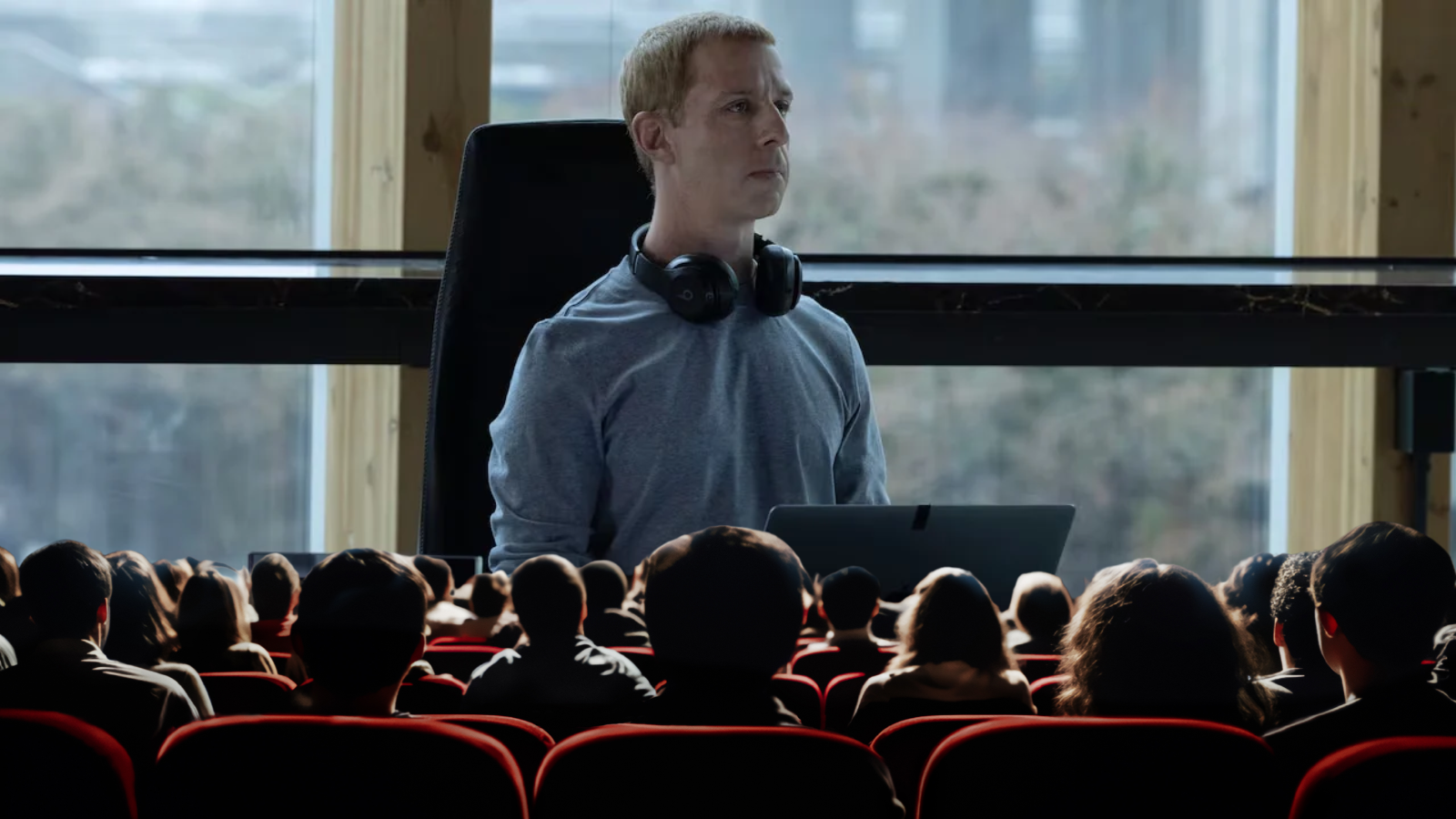
Jeremy Strong’s performance as Zuckerberg is the only standout in the film. His depiction of the tech CEO is inhuman, rude, and self-centered. In exchanges with Charlie Garrigan (Bill Burr), a fictionalized Facebook investor-turned-critic, Strong’s intensity pairs well with Sorkin’s dialogue. Still, the character is a stereotype: Zuckerberg is mostly an evil man sitting in a giant office.
The rest of the acting is mostly one-note: dialogue is rushed through, and everyone sounds the same, so White and Madison have little room to make Horwitz and Haugen their own. Some of the conversations feel manufactured, and Haugen’s fear never goes anywhere: she panics about getting caught in every other scene, then shows up to the next meeting with Horwitz ready to leak more. Side characters like Kayleigh (Portia Doubleday), a former friend of Haugen’s who was radicalized on Facebook, are underdeveloped.
The direction is flatter still. In his fourth feature behind the camera, Sorkin takes no big swings, opting for TV-movie framing with constant over-the-shoulder cuts and flat lighting. Occasional shots of the Menlo Park skyline are the only things to break it up. That’s surprising, since cinematographer Jeff Cronenweth also shot The Social Network. Yes, tech happens indoors, on laptops, under fluorescent lights but Conenwell showed audiences in 2010 that even The soundtrack as well is bland and uninspired, a clear step down from the Oscar-winning music of the first installment.
Most disappointing of all is the writing, long Sorkin’s calling card. The film leans heavily on exposition. Viewers are told repeatedly that Horwitz may not legally pressure Haugen to break her nondisclosure agreement, and long monologues explain tech jargon. Sorkin also concentrates much of his writing on vague statistics and numbers. It’s 64% this, 32% that. A depth of understanding is thrown out in favor of covering a wide breadth of studies and factoids. Even during emotional moments, like a touching scene where a young girl recounts her experience with cyberbullying, Sorkin is eager to quantify: the bullies made 11 different hate pages, the girl’s father says.
The structure doesn’t help. Jumping back and forth between the investigation and Zuckerberg’s testimony prep doesn’t add much, and it makes the story harder to follow. There’s also no real time pressure, as the Wall Street Journal never appears willing to pull the investigation or issue a hard deadline.
Madison’s character development is one of the few bright spots in this movie. At the start, Haugen must present her findings to others using notecards. By the end of the film, she is testifying alone in front of Congress. She also learns to expand her identity beyond her job. Initially, Haugen struggles to describe her interests outside of work when setting up her dating profile bio (“I am a data scientist,” she modestly writes). By the end of the movie, she celebrates her testimony by punching the air, an expression of elation she previously could not understand.
Sorkin’s ambition for The Social Reckoning suffers from a lack of focus. The film seeks to dramatize the impact of Facebook’s algorithm, but does not trust the audience to draw their own conclusions. Garrigan’s heated confrontations with Zuckerberg don’t just spell it all out for Zuckerberg, but also for everyone watching. And worst of all, Sorkin’s message is boring: Facebook is doing harm by favoring engagement over user safety. Duh.