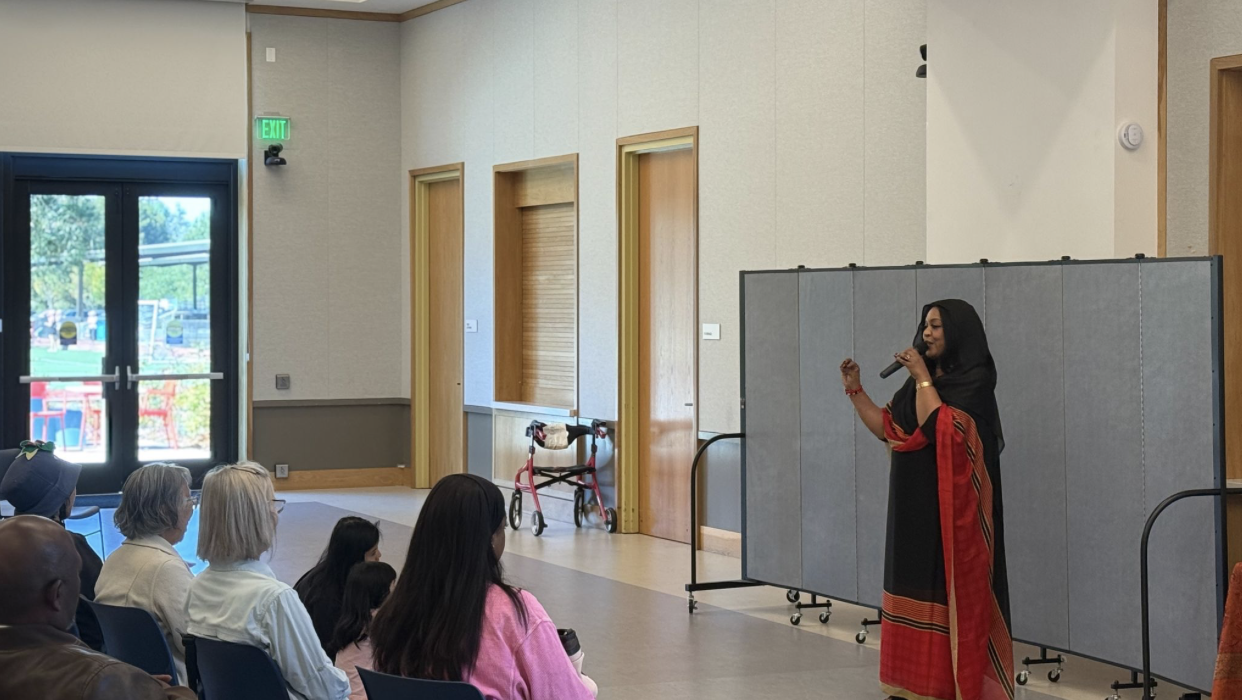
Hana Baba, the host of KALW’s show Crosscurrents and creator of the award-winning podcast Folktales from Sudan, performed three traditional Sudanese stories at the Belle Haven Library on Sunday, Oct. 18. Between stories, she taught Sudanese Arabic words, asked the audience to sing along, and talked about how folktales crossed borders.
The stories have deep roots in Baba’s family. “These are the stories that I heard from my uncle and my mother and aunts that they heard from their grandmother, who traveled around Sudan and collected folk stories,” Baba said.
Her first story followed a merchant who asks his three sons how much they love him. The oldest says gold, the second says silver, and the youngest says salt. The insulted father banishes the youngest. Decades later, the father, now old and hungry, knocks on the youngest son’s door without recognizing him. The son takes him in and serves him a meal cooked without salt, and the father finally understands what his son meant.
Baba paused the story to explain why the son welcomed a stranger. “If a guest, a stranger, comes, knocks your door, and is in need, you open your doors to them and you feed them, and you help them because that’s what neighbors do,” she said.
Along the way, she taught the audience words including Shukran (thank you), Samak (fish), and Bamia (okra). She also described the zir, a clay pot that cools water overnight, and the sineya, the large tray that Sudanese families gather around to share a meal.
“It’s fascinating to me how stories and folktales travel,” Baba said.
In “Lolaba and the Eagle,” a boy catches an eagle that promises him livestock and then jewels if he lets it go. The boy keeps demanding more until the princess Lolaba appears, and he drops the net. The eagle turns back into a king, and the riches vanish, leaving the boy with nothing because of his greed.
The final story featured a brother and a sister, Fatma and Muhammad. There are animals including a hook, or ogre, who tries to imitate Muhammad’s young voice to get through Fatma’s door. Baba softened the ending for her young audience.
Baba’s family was helping run the event. Coloring packets made by her cousin were handed out with QR Codes linking to Baba’s podcast. Folktales from Sudan has 20 episodes on Apple Podcasts, Spotify, and YouTube.
Baba’s family helped run the event, and they handed out coloring packets illustrated by her cousin, with QR codes linking to the podcast. Folktales from Sudan has 20 episodes on Apple Podcasts, Spotify, and YouTube. Baba said families tell her they listen together in the car or at bedtime. “It’s just audio and no screens,” she said.
Baba told stories passed down from her great-grandmother, and listeners from Romania to the U.K have recognized them. For her, the stories were never just meant for just one audience.
“Folktales were really originally for everybody,” she said.