9/10
Judging by the trailer, Wild Horse Nine looks like a standard action-packed detective film. And while the movie certainly delivers on the action, its two detective protagonists aren’t hunting for a stash of weapons or a missing person. They’re searching for closure.
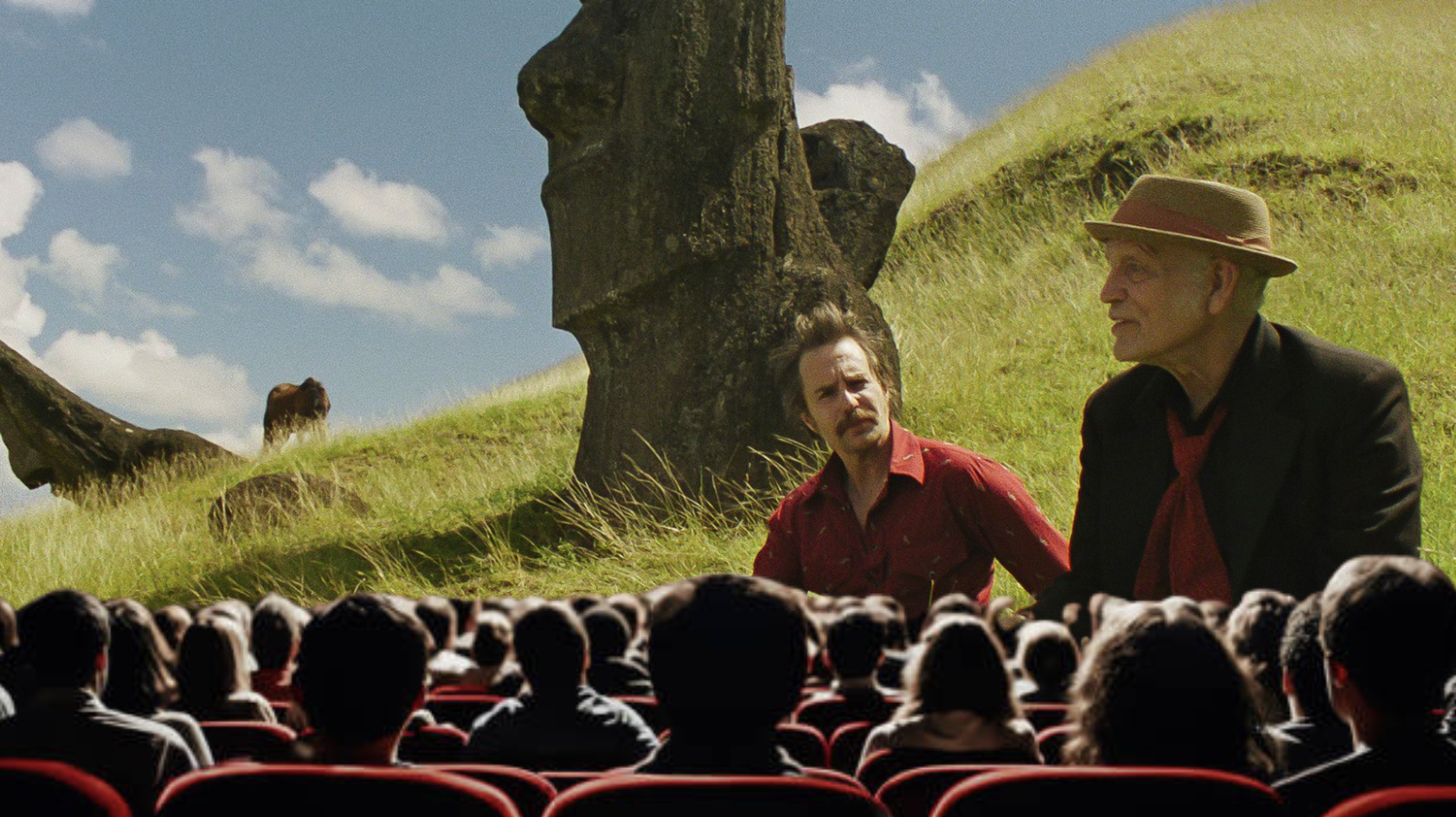
The film opens with an aging CIA operative named Chris Carlisle (John Malkovich) and his younger partner, Detective Lee Chesterfield (Sam Rockwell), setting off on vacation to Rapa Nui as Carlisle’s final getaway. Although Carlisle often dominates their conversations, Chesterfield is more than just his sidekick. His youth and contrasting presence create an interesting dynamic, especially as he must navigate partnering with someone whose memory and judgment are increasingly unreliable. The film quickly reveals that Carlisle’s real battle isn’t with an enemy; it’s with his own fading memory. Carlisle appears unusually old for a CIA agent, but despite his age, he has no trouble maintaining his authority within their partnership.
However, just minutes into the movie, you start to see the cracks. Carlisle struggles to remember big chunks of his life, and worse, he forgets that he cannot reveal he is a CIA agent or the top-secret information he is given. This first becomes apparent when he warns two young girls at the airport about their country’s future. One of the girls, Monica (Mariana di Girolamo), is a Chilean university student who repeatedly crosses paths with the agents. Through her clashes with Carlisle, she challenges his lifelong habit of lying and forces the dying operative to confront his guilt, giving him one last person whose future he can genuinely protect.
Director Martin McDonagh amplifies the isolation through the use of setting. Rapa Nui, commonly known as Easter Island, is located roughly 2,300 miles west of continental Chile, making it one of the most secluded inhabited islands in the world. There, the two agents are surrounded by sprawling green hills, wild horses, and towering moai—the massive, ancient stone statues carved by the island’s indigenous people. After visiting Rapa Nui 13 years earlier, McDonagh was inspired to use the island as a core setting.
Instead of using the island as a pretty backdrop, the movie uses its isolation to trap Carlisle in his own thoughts, making it impossible for him to run from his past.
Many of the film’s scenes feel particularly tied to this distinct setting. When Carlisle approaches Monica on the beach to apologize for his earlier inappropriate, derogatory jokes about the moai, which she overheard, Carlisle instinctively falls back on the lie that Chesterfield is the one dying rather than himself.
Once Monica calls his bluff, however, Carlisle uncharacteristically drops the cover story and admits the truth about his own terminal illness. Having spent decades manipulating others through espionage, Carlisle abandons that lie. Confronting the end of his life, he finally trades CIA deception for honesty and genuine human empathy. In doing so, this vulnerability pivots the film away from a lighthearted thriller, anchoring it instead in a deeper portrayal of mortality and the weight of a life spent in deceit.
Hours after Carlisle’s heartfelt moment with Monica, he eagerly arrives at the dimly-lit bar to join her. She greets him happily, but her friend Alicia (Ailín Salas) is less than thrilled to see him. They start to warm up to each other and enjoy the music until Carlisle makes an out-of-pocket comment that folk singer Victor Jara (Arón Hernández), who is performing in front of them, is on the CIA’s execution list. “I do like him, actually. He’s on a lot of our lists, actually,” he says.
While Jara sings, Carlisle breaks protocol and bluntly reveals to Monica and Alicia the grim fate awaiting activists like them. At first, Monica listens in stunned disbelief as he coldly describes the imprisonment, torture, and kidnapping that await people like her. He tells her to fight to the death rather than let soldiers take her away. Deeply disturbed by this confusing remark, she tearfully asks him why he is telling her all of this. Carlisle replies that he is only following her earlier advice to stop lying. It’s a heartbreaking scene because Carlisle isn’t trying to be cruel, and it shows that someone who spent his whole life lying doesn’t know how to be honest without hurting people.
Later that night, Carlisle sits alone in front of the moai with a drink and a gun, venting his frustration until the wild horse from earlier approaches him. Instead of his usual cynicism, he softens and strokes the horse as it sniffs him, seemingly sensing how close he is to death. Carlisle laughs it off with dark jokes to hide his fear, instead revealing his vulnerability. Surrounded by the horse and the ancient statues, his bitterness finally fades, showing that he’s stopped running and accepted his fate.
Despite their differences, Chesterfield clearly cares deeply about Carlisle, and their relationship goes beyond simply being coworkers. His concern for his partner adds an emotional weight to the story, as it becomes clear that Carlisle is not facing his final days without someone who cares about him. Chesterfield’s loyalty also makes their partnership more meaningful, showing that even in a world built around secrecy and deception, genuine human connections can still exist.
What truly elevates Wild Horse Nine is its balance between tense thrills and sentimental personal moments. When the gunfire ceases, the story never drags, and the quieter scenes deepen the investment instead. Rather than hurrying from one action sequence to the next, the film gives its characters space to unravel, ensuring that the final emotional significance pays off.
At the end of the day, Wild Horse Nine succeeds because it doesn’t just rely on action to keep you hooked. Underneath the detective plot, it’s an honest story about trust, letting go of the past, and finding peace.