

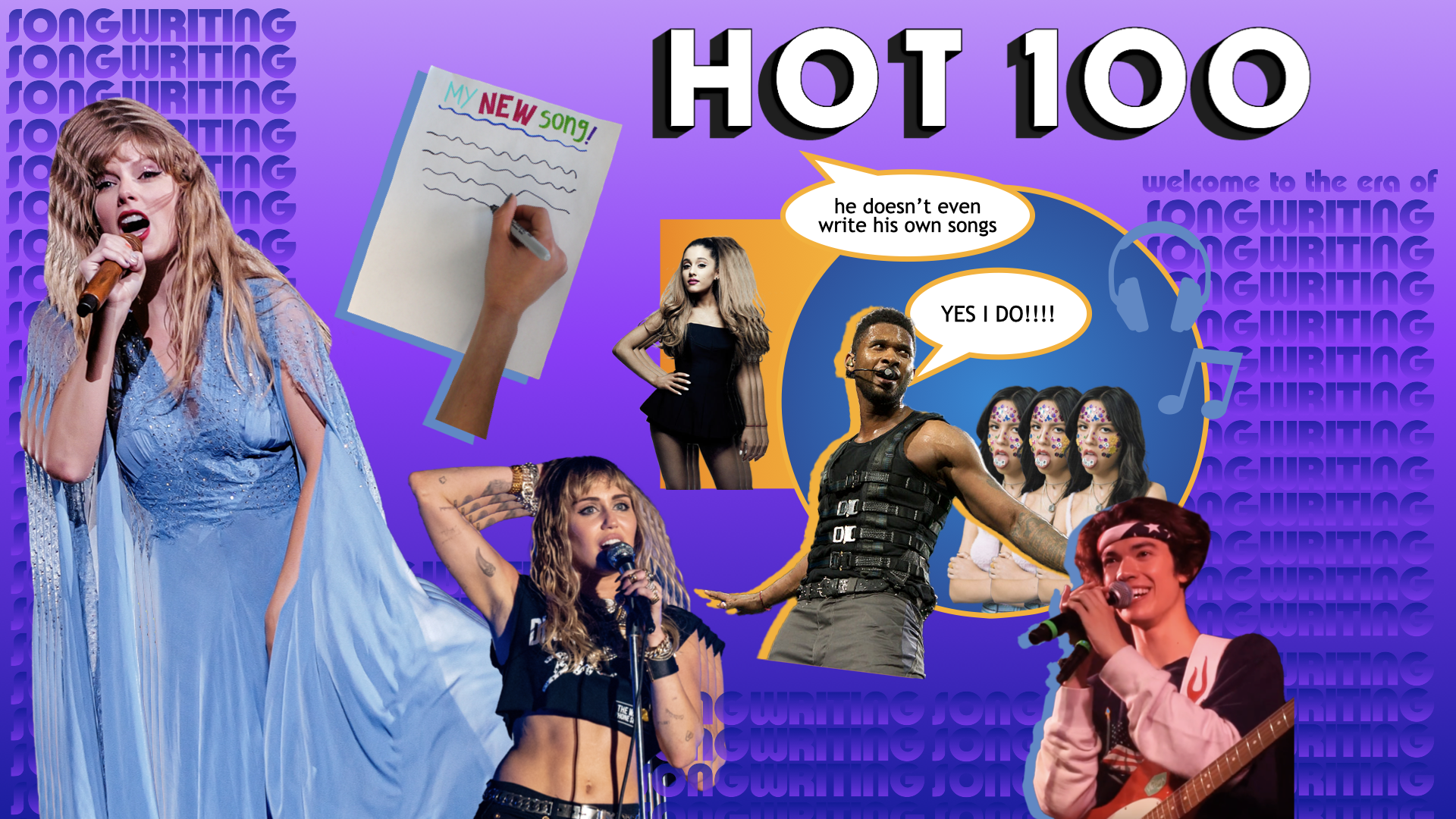
When a pop star is mentioned, say, Rihanna or Katy Perry, a common response is: “She doesn’t write her own music.” That may have once been true—but not anymore.
In the past decade, mainstream pop music has seen a growing trend of artists writing their own songs. On Billboard’s annual Year-End Hot 100 Singles chart, 61% of the songs in 2000 credited the artist as a songwriter, whereas 95% of the songs in 2020 credited the artist as a songwriter.
Until the 2010s, pop singers—especially those promoted to stardom by labels or previous Disney fame, like Miley Cyrus, Usher, and Selena Gomez—rarely wrote their own music. But in the past few years, those artists have received more and more songwriting credits for their original music.
For example, Rihanna is credited as a songwriter on about 33% of the songs on her debut album, and about 92% of the songs on her most recent album, ANTI. In fact, the only song on ANTI that does not credit Rihanna is a cover of a Tame Impala track, rather than an original song.
There have always been popular songwriters, of course. The ‘60s had Bob Dylan; the ‘70s had Carole King and Joni Mitchell. But these artists were often seen in their own separate singer-songwriter genre. In mainstream pop, many of those decades’ stars were focused on being performers without needing to write their own songs. Though some artists, like Michael Jackson, could fall into both categories, pop stars like Whitney Houston and Celine Dion relied on their vocal power rather than lyrical prowess.
And it’s not just veteran artists; most of today’s rising stars prioritize songwriting. Olivia Rodrigo, who burst to the top of the charts with her debut single “drivers license” in 2021, consistently emphasizes her focus on songwriting. Other upcoming pop artists, like Gracie Abrams, are known for their songwriting, which isn’t akin to the rising pop acts of previous decades, like Britney Spears or NSYNC.
Why is this happening? Perhaps it has to do with listeners craving relatability. “I feel like people are looking for authenticity and freshness in new music, and songwriters can connect with their listeners through their lyrics,” Ryann Barnes, an M-A ‘23 graduate and rising pop singer-songwriter, said. “I also think it’s just so common now that it’s the new norm for people to write their own stuff.”
However, on a poll on the M-A Chronicle’s Instagram account asking if viewers care if an artist writes their own music, 55% voted yes and 45% voted no.
“I feel like writing your songs makes you a more whole artist,” senior Zachary Gosler, who voted “yes,” said. “Otherwise, it doesn’t feel as genuine or artistic, and it kind of feels like the singer is only doing it for money.”
“As long as the writer is credited, I don’t care. Singing and writing are so different so I wouldn’t expect both,” freshman Felix Crim, who responded “no,” explained.
Well-established artists who started their careers without writing their own music may want more creative control over their work as they develop artistically. As Rihanna has increased her quantity of songwriting, her music has strayed from safe radio pop to become more creative. And as some artists start to write their own music and become more involved in the creative process, others likely want to follow suit in order to stay on-trend.
“I think artists nowadays have to be their own everything because it’s so accessible to release your own music,” Barnes added. “Everyone is just trying to find what makes them different to stand out, and writing your own music is a great way to have individuality.”
As it seems to be with everything these days, Taylor Swift’s impact shouldn’t be dismissed. Swift, who is hailed as one of today’s best songwriters and became famous for her personal and relatable lyricism, has inspired a new generation of artists to write songs.
“I’m obsessed with the way that Taylor paints pictures and her imagery is fantastic and her storytelling is insane,” Rodrigo told MTV News. “I listen to music that my idol made, watch all of their interviews, then go back and be like, ‘Okay. I’m going to write a song as if they were writing this song.’”
This Insider article lists eleven stars who have credited Swift as their inspiration to write songs, including Conan Gray, who told GQ that “Taylor raised an entire generation of songwriters. She taught a lot of people how to write pop songs.”
Part of Swift’s popularity, for better or for worse, is a result of widespread gossip about her private life, much of which is stirred by her songs detailing personal relationships. People love to speculate about the meaning and stories behind her lyrics, a key selling point of her work. Thus, if speculation about the singer’s life is important to some listeners, sharing personal stories can bring in a large audience.
The importance of personal storytelling is also relevant in terms of relatability. Artists who share their own experiences can be relatable to listeners who see themselves in the lyrics. “I feel like so much of listening to music is about connecting to the lyrics,” junior Ayla Karadogan said. “So, when you find out that what you’ve been listening to and relating to isn’t really written by the singer, you’re like, ‘Who am I relating to?’ and it creates a rift with how you relate to the song.”
Though the data collected from Billboard charts proves an increase in performers’ involvement in the songwriting process, it also displays a significant increase in the number of songwriters per song. This Rolling Stone article describes the decrease in solo songwriters on pop charts over the past decade, and how a double-digit songwriter count has become typical.
Eight songs on the Hot 100 in 2000 were written by the artist as the single songwriter, whereas only one song on the 2020 chart was written solo. Since all contributions to a song’s lyrics and melody have to be credited, it is possible that some artists are using a loophole to claim songwriting credit by writing just one or two words of the song.
From an artist’s perspective, writing your own music facilitates a greater connection with your audience and makes you unique within the industry. From a listener’s perspective, an artist who writes their own music often seems more personable, artistic, and authentic than one who doesn’t. And as writing your own songs continues to become an industry norm, this trend shows no sign of stopping.



Why would you mention Katy Perry in the first sentence of your article when she has written 100% of her music?