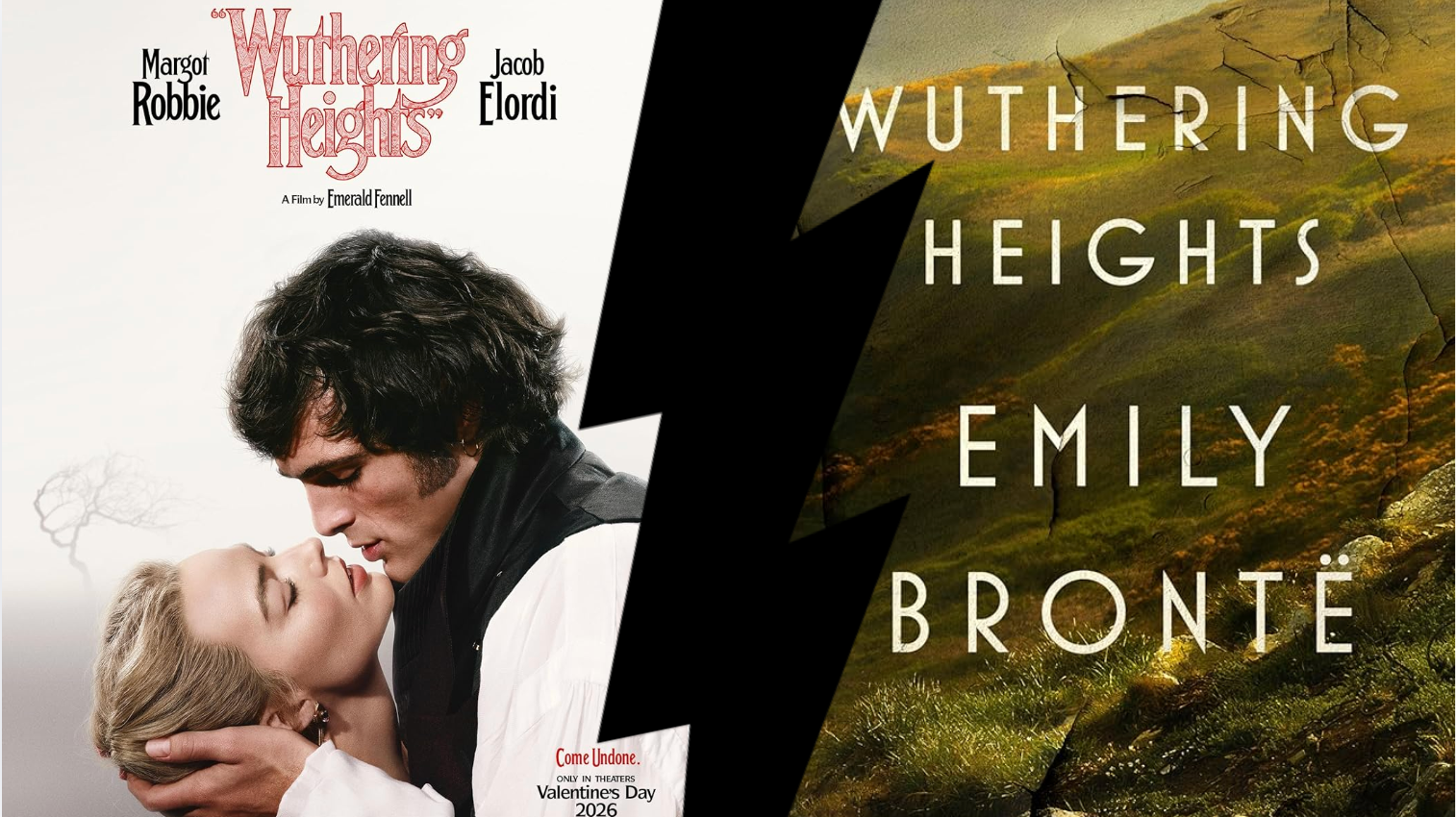
Some love stories are sweet. Some are messy. Then there’s Wuthering Heights.
Few novels are as haunting and emotionally complex as Wuthering Heights, which makes its film adaptation feel distant. By only covering the first half of Emily Brontë’s novel and reshaping the central themes, Emerald Fennell’s movie sacrifices the elements that make the original unforgettable, creating, in essence, a whole different story. Brontë’s novel is not a conventional romance but rather an exploration of the effects of abuse on children and the lasting effects of trauma on their relationships. While the movie appeals to some audiences, booklovers are likely to find it disappointing.
The film version opens with a macabre hanging scene that is absent from the book, immediately signaling a departure from Brontë’s narrative. Fennell takes many liberties with the plot to emphasize her interpretation, which centers on obsessive and forbidden love. Most significantly, Catherine Earnshaw and Heathcliff don’t have a sexual relationship in the book, and Fennell does not cover the second half of the novel, removing the multi-generational arc that gives the original story its depth and replacing it with an enthralling love story.
Instead, the second half of the movie is spent following Catherine and Heathcliff wandering the moors together, offering little narrative development or progression. While this lack of structure is already unsatisfactory, the emphasis on physical intimacy instead of the deeper connection featured in the book further distances the relationship between the two.
The book provides its readers with a more traditional happy ending, with the next generation planning to get married, providing a well-deserved conclusion that leaves the reader feeling satisfied. In contrast, the film ends with Catherine’s death instead of a conventional resolution. In the book, Catherine dies halfway through. Fennell’s tragic ending feels surprisingly refreshing compared to the predictable, cliché happy endings often found in other stories.
Two scenes from the book are directly inserted into the movie, while other, arguably more valuable scenes with similar significance, don’t show up at all. The scene where Catherine admits to Nelly that she is in love with Heathcliff—as he listens at the door—is almost copy and pasted into the movie. This includes arguably the most famous line in the novel, “Whatever our souls are made of, his and mine are the same.” Similarly, when Catherine and Heathcliff reunite Fennell uses more iconic lines from the book such as, “I have not broken your heart—you have broken it; and in breaking it, you have broken mine.” The scenes included are portrayed effectively, and the actors capture the exact emotions and tone as described in the book, so one would hope that there was more accurate overlap between the two.
Not only does the storyline differ from the book, so do the characters. One of the two main narrators, Lockwood, is completely absent from the movie despite his influential role in the book, offering an outside perspective on the family affairs. In the book, Catherine’s brother Hindley despises Heathcliff, but Old Mr. Earnshaw adores him, however, in the film, Hindley doesn’t exist, and instead it is Old Mr. Earnshaw who hates Heathcliff and abuses him. Joseph, the servant, is pious and infuriating in the novel, making him comedic relief, but in the movie, he is portrayed as a simple side character. Additionally, in the book, Catherine descends into madness before her death, and Edgar Linton is portrayed as kind, loving, and gentle, serving as a clear contrast to Heathcliff. In the movie, however, Edgar is bitter and cold, especially towards Heathcliff, which directly conflicts with his demeanor in the book.
Rather than centering on romance, the book primarily examines the cycles of abuse and manipulation that are prevalent in the lives of Catherine and Heathcliff. The movie reframes this connection as a passionate romance, emphasizing a physical relationship that doesn’t occur in the book. Although the movie is considered an interpretation of the book, it misses some of the themes that make the book a classic.
More notably, Heathcliff is portrayed as a man of color in the novel, which is a key reason to why he was an outcast and unfit to marry Catherine. However, in the film, he is played by Jacob Elordi, removing that significant aspect of his character. By eliminating this element, the adaptation loses one of the novel’s most provocative conflicts and leaves audiences questioning why society is so adamant that Catherine and Heathcliff can’t be together.
The concept of a sweeping love story is also not captured in the book, yet the film elevates it to the primary focus. The shift likely reflects modern audiences’ preference for romantic narratives over stories centered on abuse, hatred, and psychological manipulation. By prioritizing romance, the movie transforms the darker, complex themes into a more commercially appealing but far less nuanced film.
The movie appears deliberately shaped to appeal to a younger audience drawn to twisted love stories and stereotypical kissing in the rain scenes. In contrast, the book is far more intellectual, requiring readers to piece together layered narration and confront themes of longing and manipulation. Rather than offering a romantic spectacle, the novel challenges its audience to grapple with uncomfortable truths about obsession and its consequences.
If you came for the film’s sweeping romance, the book might break your heart, but its passion, obsession, and unforgettable story will captivate anyone who doesn’t need a happily-ever-after.