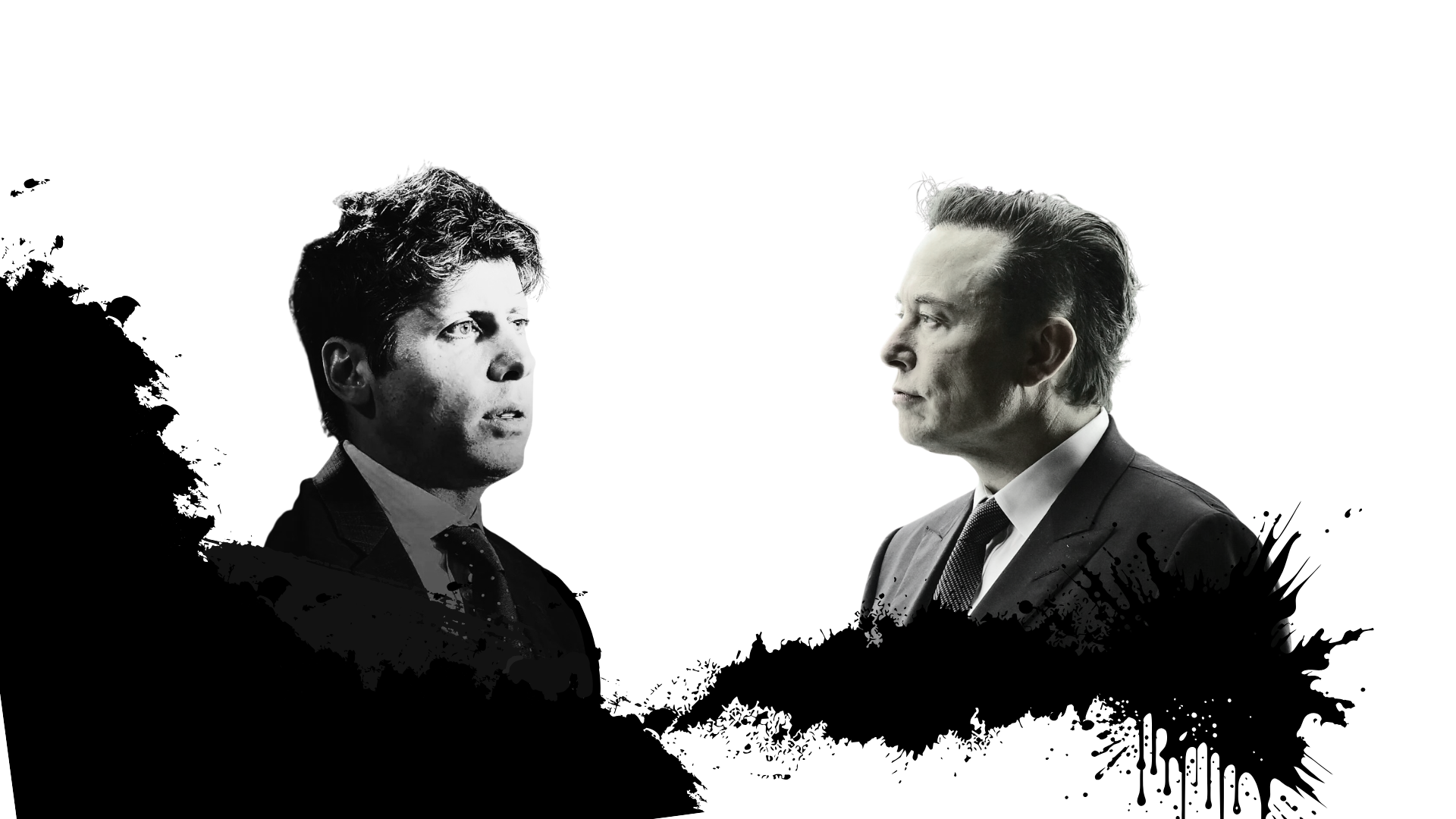
After three weeks of courtroom drama featuring some of the biggest names in AI, Elon Musk’s trial against OpenAI CEO Sam Altman, president Greg Brockman, and Microsoft came to an end last week. The jury’s verdict: Musk brought his lawsuit too late, dismissing all claims against Altman.
To many M-A students, the trial in Oakland has seemed a world away: a cast of feuding billionaires, unthinkable sums of money, and a power struggle over the development of artificial general intelligence (AGI).
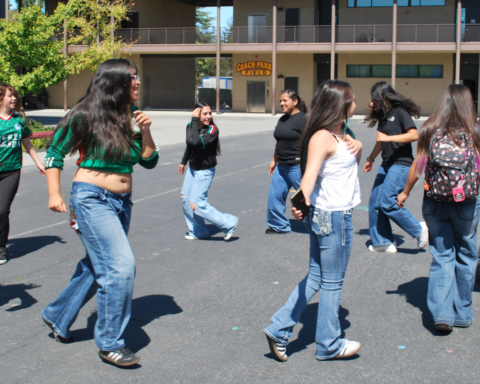
Yet debates over AI use at M-A have been unfolding rapidly. Use of ChatGPT and Gemini is widespread among students, and Principal Karl Losekoot has encouraged the use of AI by teachers in the classroom. The District also recently rolled out an AI learning platform, which received mixed reviews. However, in the absence of formal guidance, some students are concerned about damage to academic integrity and the learning process. Students and teachers are figuring out how AI changes education in real time.
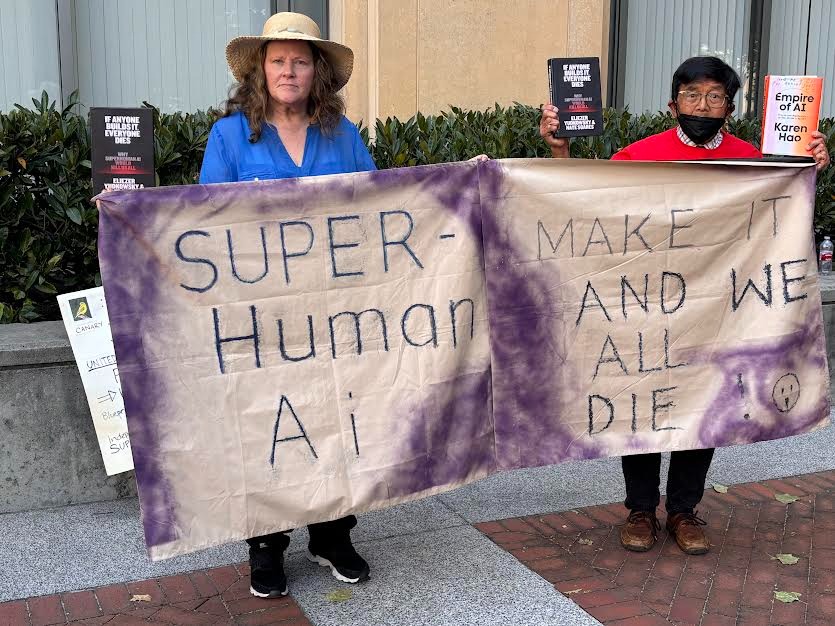
The M-A community’s experience is a microcosm of the turmoil over AI governance worldwide. Activists outside the federal courthouse compared this to a nuclear arms race. “Imagine an intelligence explosion in which AI is 100 times smarter than us; we will be a little ant on the ground,” Bill Lo, a community member, said. Others populated the area outside the courthouse with miniature coffins, posters, and flowers in tribute to job losses, deaths, and other ills caused by AI.
The case’s underlying allegation was that Altman and Brockman “stole a charity” for their personal enrichment by commercializing and restructuring OpenAI, which was originally co-founded by Musk as a non-profit with a mission to develop AGI for the benefit of humanity. OpenAI has since become a for-profit giant with a valuation nearing one trillion dollars and is rumored to be considering an IPO. Musk also accused Microsoft of aiding and abetting Altman by pushing for the restructuring. He sought 134 billion dollars in damages, the removal of Brockman and Altman from OpenAI’s leadership, and the dismantling of its for-profit structure.
The nine-person jury deliberated for less than two hours before making its recommendation to Judge Yvonne Gonzalez Rogers, who has overseen other landmark tech cases at the Oakland federal courthouse, such as the Epic Games v. Apple dispute over App Store rules. William Savitt, lead counsel for Altman and OpenAI, commented on his victory. “Mr. Musk’s lawsuit was an after-the-fact contrivance by a competitor,” he declared, referring to Musk’s interests in his own AI Company, xAI, which is set to go public as part of SpaceX in June. Elon Musk’s counsel disagreed, calling the outcome a great loss for Americans.
It’s no secret that the case has been fueled by a bitter rivalry between Musk and Altman, both of whom are tech billionaires obsessed with the pursuit of AGI. Musk texted his opponents two days before the trial began, after they refused to settle. “You and Sam will be the most hated men in America. If you insist, so it will be,” he wrote. Since Musk left OpenAI in 2018, tensions had mostly played out on X and in blog posts; more recently, they spilled into the courtroom through texts, emails, Slack messages, diary entries, and cross-examination. Musk’s case was a relentless attack on his former partners’ credibility and suitability to lead the development of AGI. Neither side has emerged unscathed.
When OpenAI was cofounded in 2015 by Musk, Altman, Greg Brockman, and prominent researcher Ilya Sutskever, the group shared a common concern: that advanced AI, and especially AGI, should be developed in a way that benefits humanity. This, they felt, could not be safely entrusted to a purely for-profit corporation like Google, which then had a large lead in the field. OpenAI was the underdog with a “1% chance” of success, per Elon Musk, who agreed to donate $38 million between 2015 and 2020.
The release of ChatGPT marked a turning point in 2022, with the platform amassing 100 million users in less than two months. Alongside this success, complaints and concerns related to Altman’s leadership grew louder, prompting the board to take drastic action in November 2023. Altman was fired over his lack of “trust, accountability, and oversight because of potentially severe risks and safety issues,” Helen Toner, one of OpenAI’s former board members, said. According to multiple video depositions from board members at the time, Altman’s dishonesty and “toxic culture” led to a “series of crisis events.” The prosecution portrayed Altman as a pathological liar.
Altman’s firing was also rooted in his inability to allow significant board oversight. In November 2023, he released ChatGPT4 Turbo without it undergoing the required safety review or notifying the board. Per the board, the incident was one of many in a series of transparency issues and lapses in honesty.
“Imagine that you’re on a hike, and you come upon one of those wooden bridges that you see on a trail, and it’s over a gorge,” Musk’s lead counsel, Steven Molo, told the jurors. “There’s a river that’s 100 feet below, and it looks a little scary, but a woman standing by the entry to the bridge says, ‘Don’t worry, the bridge is built on Sam Altman’s version of the truth.’ Would you walk across that bridge? I don’t think many people would.” Several jurors chuckled.
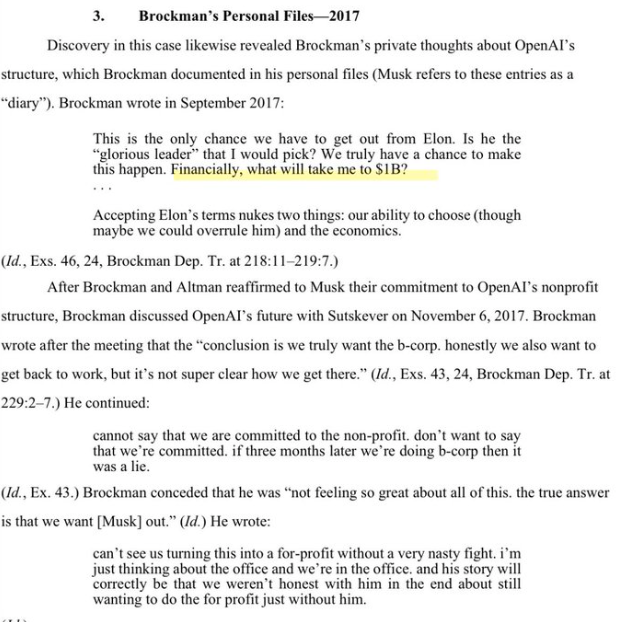
Musk set out to prove that Altman and Brockman used OpenAI for personal gain rather than the greater good, using excerpts from Brockman’s personal diary: “Financially, what will take me to $1B?” Brockman wrote to himself in 2017. He also explicitly contemplated converting from a non-profit to a for-profit, and how Musk would react to “a lie.” Brockman’s stake in OpenAI is now worth $30 billion. Musk argued that his original donation was treated as seed money for a startup in which he received no equity. “I gave them $38 million of essentially free funding to create what would become an $800 billion company,” Musk said while testifying in court.
An expert witness for Musk, former Columbia Law School Dean and tax scholar David Schizer, argued that OpenAI’s part-for-profit, part non-profit structure had effectively become profit-driven over the years. Schizer testified that the structure allowed for the for-profit slice of OpenAI to grow exponentially, leaving the non-profit with an ever-smaller residual. The 20% annual rise in Tax Receivable Agreement payments returned to investors shrank the residual, depleting the nonprofit’s funds. “This means that you are making money for specific individuals, which is precisely what non-profits cannot do,” Schizer said.
Musk’s lead counsel leaned into this theme in his closing arguments: “Imagine someone robs a bank of $1 million,” Molo told the jury. “It’s not a defense to say, you only took $1 million and left $100 million in the bank… and that’s essentially what they’re saying,” Molo said.
OpenAI sought to discredit the board members as incompetent or beholden to Musk. The board was “amateur city,” Satya Nadella, CEO of Microsoft, said. Altman’s firing ultimately destabilized the company and led to his reinstatement five days later as the company hurtled towards total disintegration.
Another early board member, Shivon Zilis, was discredited for her personal relationship to Musk. She testified that she lost trust in Altman and Brockman after learning of plans to close deals at OpenAI with companies in which they had personally invested. This, she said, would lead to a possible conflict of interest and difficulty in upholding their fiduciary duty to the non-profit. During cross-examination, the defense asked whether she had had a romantic relationship with Elon Musk, besides being his co-parent of four children via IVF. “Sure,” Zilis replied, prompting side-eyes in the courtroom.
Another witness for the prosecution, Rosie Campbell, a former policy researcher at OpenAI, was among the 751 of 800 OpenAI employees who signed a petition calling for Altman to return as CEO during the ouster period. “My understanding at the time was that the best way for the mission to continue was for Sam to return,” she said. However, Campbell, along with many others, left in November 2024 after OpenAI dissolved several dedicated safety teams, including the Superalignment Team and the AGI Readiness Team.
Above all, the defense portrayed Musk as having ulterior motives. If he believed OpenAI should remain a nonprofit, they asked, why would he later found a competing for-profit AI company? They also argued that Musk had long been aware of OpenAI’s shift toward commercialization.
As Judge Gonzalez Rogers told the court: “It all comes down to whom the jury chooses to believe.” In his closing argument, Savitt pointed to Altman and Brockman. “Mr. Musk isn’t here today. My clients are,” Savitt said. “Mr. Musk came to this court for exactly one witness: Elon Musk. Now he’s in parts unknown.” Unmentioned in court, Musk was, at that time, on state business in China with President Trump and other American CEOs.
With the verdict now in and claims dismissed, questions arise: Was there more to this case than drama between billionaires? Should they have simply settled behind closed doors? Regardless, a core message prevails: the safety and proper governance of AGI is imperative now more than ever.
“Students these days rely a lot on AI, and overwhelmingly, the negatives have outweighed the positives,” freshman Nathaniel Chung said. Musk plans to appeal the verdict, and the outcome of the AI race remains uncertain. Meanwhile, no one is immune.