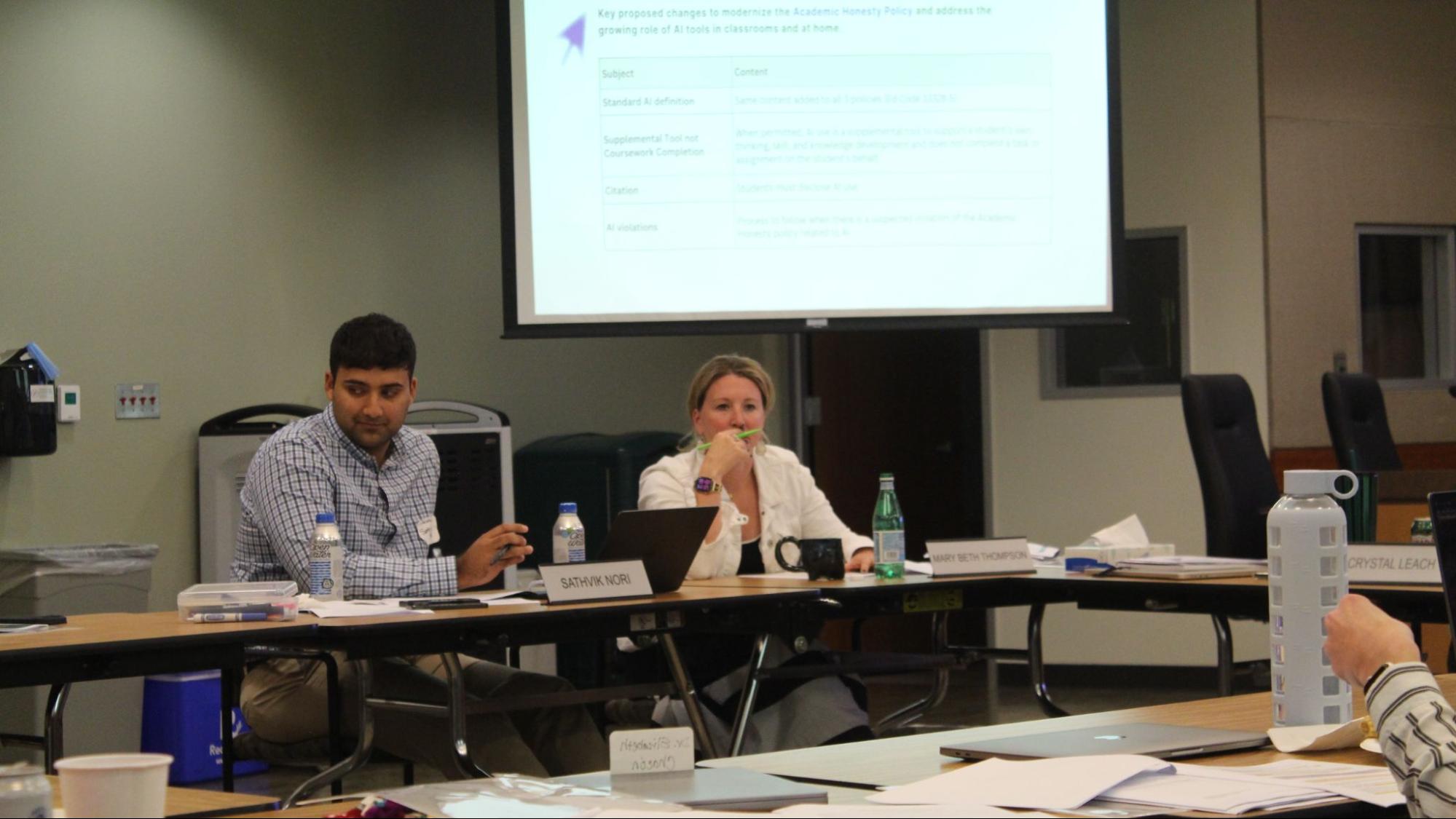
The District Board of Trustees convened for a special study session on Wednesday afternoon. The Board reviewed the use of artificial intelligence and its AI policy drafts.
The drafts that the Board was reviewing would rewrite three District policies and would give students suspected of cheating using AI a chance to explain their work.
The Board took no action on the drafts, which are expected to be finalized this winter.
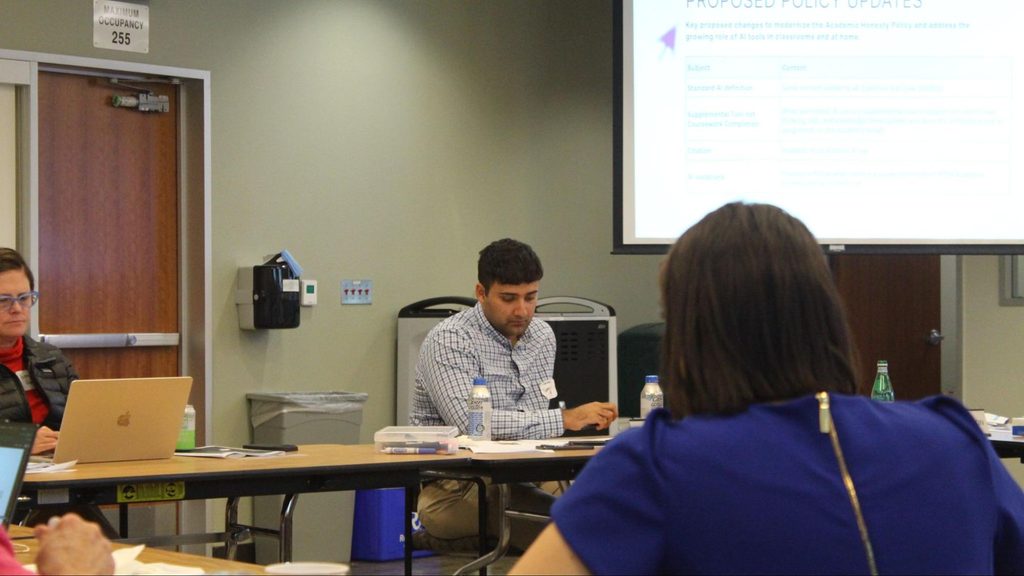
How Teachers Would Handle Suspected AI Cheating
The Academic Honesty draft requires a teacher who suspects a student of misusing AI to give the student an opportunity to “demonstrate their understanding of the content through other methods deemed suitable to the assignment by the teacher.”
Trustee Mary Beth Thompson said parents had complained repeatedly about children who failed after a teacher said they used AI. “I don’t think a teacher can just say, ‘I think you used AI,’ or, ‘This detector said AI, you failed,’” Thompson said.
She pointed to the fact that detectors often make mistakes. A University of Maryland study of a dozen AI detectors found that detectors wrongly flagged human writing as AI-generated about 7% of the time.
“I feel like if you want to address it, then you should say there’s some formal process outside of a teacher that a student can appeal to if they think they’re being falsely accused of using AI,” Trustee Sathvik Nori said.
State law makes it difficult to overturn a grade. Under California Education Code, a teacher’s grade is final unless the student can prove a clerical error, fraud, bad faith, or incompetence.
Student AI Use
If a teacher allows AI, the draft says, it should support a student’s own thinking, and students must cite their usage.
The draft lists what counts as misuse, including passing off AI work as original and generating answers on math, science, or analytical problems. Thompson questioned why the District policy would create different rules for math and science when similar concerns exist in other areas, such as music composition.
The final item, which allows any AI use a teacher has not specifically prohibited, drew pushback from the Board. “It needs to default one way or the other. You can’t use it unless your teacher has specifically said, ‘Yes, you can.” It needs to default to, ‘Don’t, you’re not going to use it,’” Thompson said. Solutionary Advisors, the consulting firm that led the session, agreed to rework that section.
Staff AI Use
Staff would face AI rules of their own. Employees who use AI must check its output, and are prohibited from entering personally identifiable information into tools not expressly allowed by the District.
The Employee Use of Technology draft would let teachers use District-approved AI to give feedback on or even grade student work. California’s model policy on the other hand calls for both consent and notification whenever AI is used for grading or feedback.
The District has not committed to adding consent. In written answers to the working group, a group made up of District staff and a Board member, it stated that consent would be discussed further, calling the state’s principles recommendations but not mandates.
Carisa Olivo, a District parent, attended the session in part because of the upcoming election. “I live in Area A, and we have a contentious school Board trustee race there,” Olivo said. “And I wanted to see if the candidate that was saying he would make an AI policy happen within a year would come to listen to hear what the Board discussed, and he was not present.”
Nori wanted trustees to review the guidance, a staff document separate from the policies, used to guide staff on how to respond to AI use by students. The document on AI guidance will be looked over by the working group in November and December and will explain how teachers should apply the policies decided by the Board.
“If the Board really wants to enforce an implementation, it needs to be in a policy,” Superintendent Crystal Leach said in response, describing guidance as staff’s work.
The Board will reconvene for its next regular meeting on Nov. 18.