Across the country, English teachers are assigning fewer books as students’ reading skills decline. According to a 2010 survey of 400 high school English teachers, high school English classes assigned an average of four books. In a 2026 survey of 1,250 high school English teachers, respondents reported that students are now assigned 2.8 books on average.
“I’m seeing far fewer students reading for fun, or bringing books to class to read during downtime, than when I was in high school. I have a lot of students who very openly discuss how much they dislike reading, or how few books they’ve actually read,” MCLV and AP English Language and Composition teacher Erin Walsh said.
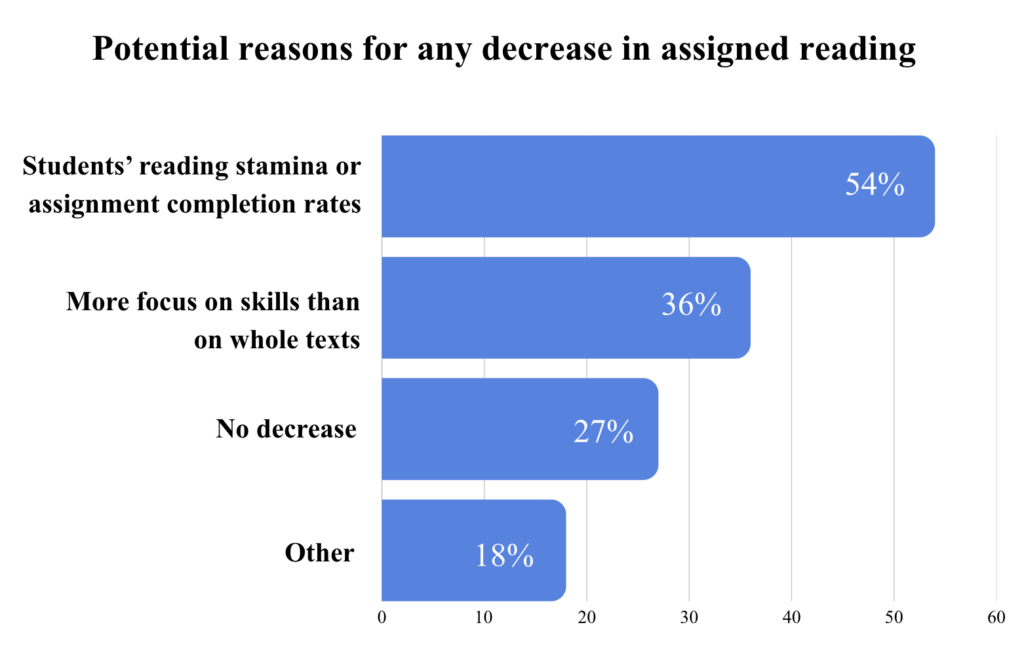
An M-A Chronicle survey found that 10 of 11 M-A English courses expect students to read entire books. However, teachers of only three courses believe that students read all of what they assign. When surveyed about reasons for any decline in assigned reading, six of the 11 courses named reading stamina or assignment completion rates as the most common contributor.
Many argue that declines in youth reading stamina are one of the broader impacts of social media use. With widespread access to short-form content, students risk shortening their attention spans, which can affect their ability to focus on texts for long periods.
“Some books are difficult to read, just because that’s the nature of the book, so I think when people don’t get the frequent dopamine hits, they want to put it down,” junior Nicolas Sandoval, President of the Paws for Prose book club, said.
“Most people I know don’t read,” junior Teagan Forcier-Koranda, Vice President of the Paws for Prose book club, said.
As a result, some teachers are assigning shorter texts to adapt to students’ reading stamina. One reason teachers may prioritize short texts like speeches, essays, and poems is that they allow students to quickly improve their analytical skills, whereas books require a greater time commitment.
“Having short stories in the beginning makes students feel more confident, more comfortable with this concept of reading, that whatever skill I’m gonna ask them to do with the reading is achievable, then they’re more likely to actually perform when I increase the length or ask them to do work at home over time,” English II and English IV teacher Daphne Pacia-McCann said.
Pacia-McCann also administers quizzes to her students when they are assigned independent reading to do at home. “More students would be likely to read if they knew there was a quiz coming every time there was independent reading,” she said. “I prefer not to give quizzes at all. The only problem with that is if I insist on being the type of teacher that forces all of my kids to read outside of class, the failure rates are just going to most likely skyrocket.”
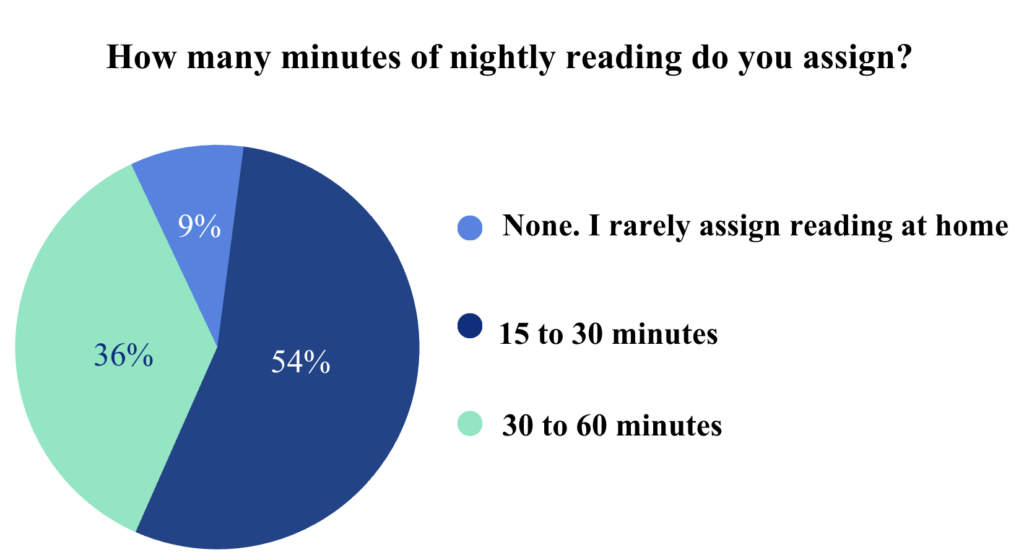
Of the 11 courses, six expect 15-30 minutes of nightly reading, and four expect 30-60 minutes. One course rarely assigns reading at home. The 11 courses surveyed included four MCLV, two AP Lang, two AS English II, one AS English III, one English IV, and one AP Literature.
MCLV and English I Support teacher Carly Balmana has students complete most of the reading in class. “We do more in-class reading to help encourage [completion]. We also sometimes chunk down at this section, so it kind of makes it a little bit more manageable than giving them, ‘Okay, you have a week to finish the chapters.’ We’ll do it little by little together,” she said.
Balmana also said that the English department as a whole has changed parts of the curriculum to make the required texts more relatable and interesting to students. “They switched to ‘Enrique’s Journey,’ which I think more students can relate to. And same with some of the short reading stories as well. With sci-fi, students seem to be more engaged than having one big text as having multiple short stories. And again, that’s to help with the digestion of reading,” she said.
Much like Pacia-McCann, AP Literature teacher Lisa Otsuka administers reading quizzes to encourage students to read texts more deeply. “I think the reading quizzes are such a fun thing because they’re challenging, but they also encourage rereading and deep reading,” she said.
Otsuka has taught English since 1991 and has seen firsthand the shifting reading habits of students over more than three decades. As a result, she adjusted her teaching methods. Otsuka never used to give retakes or allow students to revise their essays, but now she does, to strengthen their reading and writing skills.
“I feel like it is my job to teach people how to read. I have found retakes to be spectacularly helpful. It trains the eye, because part of this is you’re reading for mastery. And reading for mastery is not fast,” she said.
Senior Kannan Chotai enjoys the reading assigned in his AP Literature class. “So far, AP Lit has had a lot better books than I previously read,” Chotai said. “We’ve been reading material that’s relatively relevant, and it is actually quite enjoyable to read.”
Some teachers also assign reading for pleasure to incentivize students to read outside of class. Walsh designed an independent reading assignment for her AP Lang students, in which they read one book per quarter and then write a book review to share with the class.
“I’ve seen it a lot in AP with students, who I think are excited about reading and enjoy it, but find it hard to find time for it because of course load or extracurriculars,” Walsh said. “I think having the incentive to do it because it is worth a grade, some people like that. Some people have come to me, and they’re like, ‘Thank you. This gives me a reason to read.’”
While AP Lang primarily focuses on short texts, Walsh finds value in keeping books on the classroom agenda.
“I don’t think teaching some shorter texts is all bad. It allows us to dig deeper into parts of texts and really practice close reading. However, it’s so important to read a full-length novel from start to finish and follow a plot or argument over the course of a few hundred pages,” Walsh said.
Despite the current nationwide literacy crisis, Otsuka hopes reading will make a comeback. She sees students engaging in more analog activities instead of digital ones.
“I see a lot more students interested in going on hikes with their friends, and baking, and all the things that kind of slow you down. Reading is one of those things. It doesn’t feel good before you do it. It feels like there’s a million other things you’d rather do, but when you’re reading and after, it’s very satisfying,” she said.
Her colleagues describe the same pattern: reading takes effort, and teachers are finding ways to make that effort worth it. For Otsuka, the effort is the point.
“Life rewards the slow and steady, incremental progress that comes with deep attention and critical thinking, and really slow progress over time,” Otsuka said. “That’s what reading does. It allows us to sit with something difficult, to sit with confusion, and the not knowing, to have more patience, to really think deeply. Reading is a great metaphor for all of life’s processes that are deep and slow and take time.”
M-A teachers are committed to helping students read, whether that means reading together in class, offering quizzes and retakes, or finding new ways to give students a reason to read.