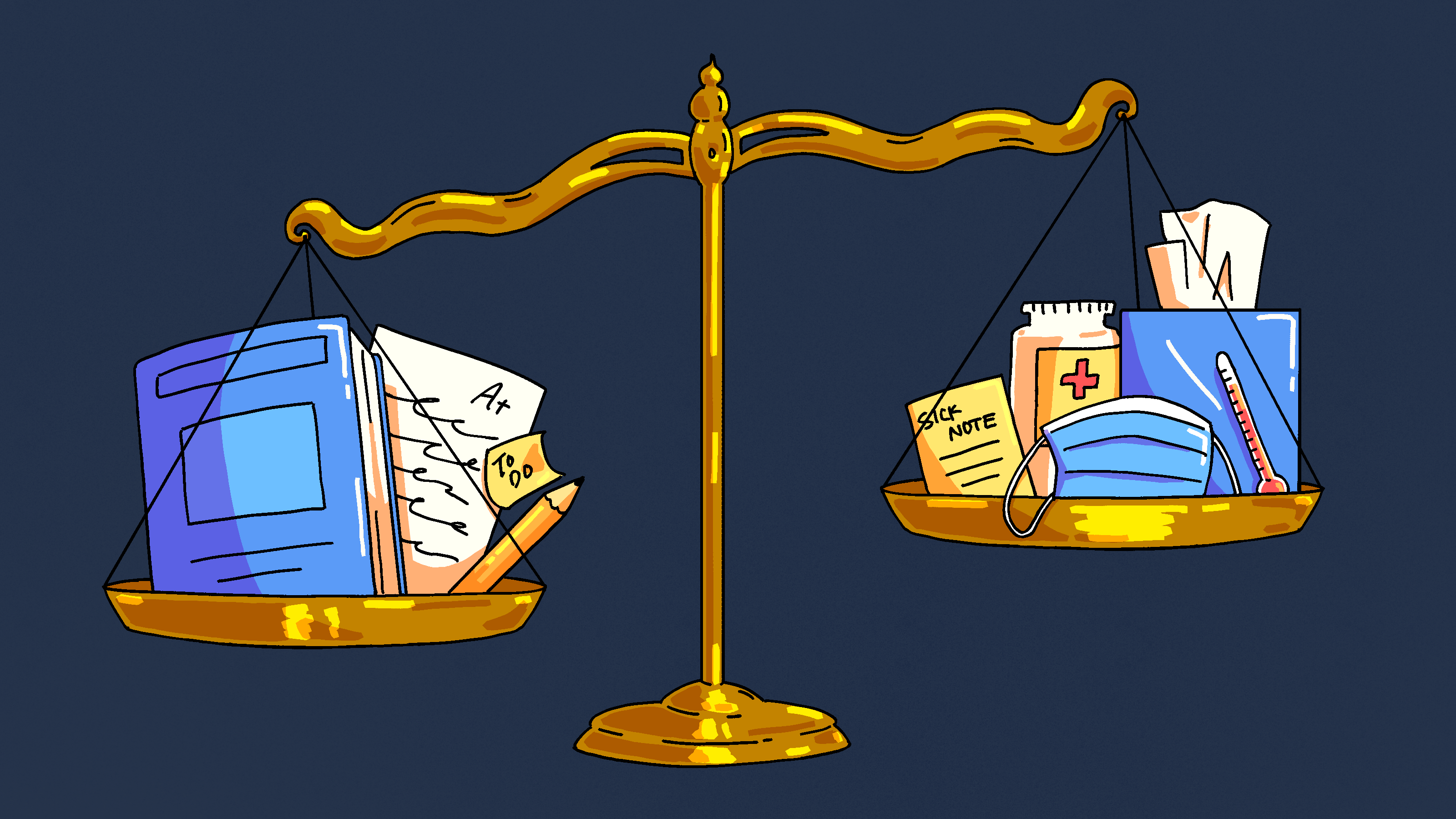
Does waking up with a cough, sore throat, or headache warrant staying home? What if there are assignments due at school? Staying home can mean resting and recovering, but also falling behind.
According to the Center for Disease Control and Prevention, children should stay home if they have had a fever, diarrhea, skin sores, severe coughing, or have vomited within the last 24 hours. However, many students and their families have their own criteria regarding when they should stay home. “I’ll stay home if I’m so sick, it’s actually a biohazard to other people,” junior Riona Nerrie said.
Often, when schoolwork and assignments are piling up, students are faced with the difficult decision of whether or not they should miss a day to recover or keep up with their studies. “I feel like there’s so many tests and presentations, homework, or classwork that you can’t really do at home, that [I feel like I] kind of have to go sometimes,” Nerrie said.
Beyond losing ground, many students see academics as more valuable than rest and recovery. “I try to find a balance because you can get burnt out if you’re completely ignoring your health, but at the same time, I think I’ll prioritize academics more,” Nerrie said.
Students, especially those taking rigorous courses, end up stretched thin between recovery and studying, but going to school raises concerns from teachers.
There’s also evidence that parents and families tend to encourage students to go to school even when they are feeling unwell. A national poll of high school and middle school families determined that when unsure of whether or not a child is sick enough to miss school, around 25% of parents decided to send their children to school.
Many teachers have observed students coming and going from school despite being ill, and expressed worry for them. “I do sometimes see kids coming to school sick, and even their parents encouraging them to do that,” social studies teacher Zoe Mahony said. “I always encourage kids to [stay home] if they’re sick, because their health is more important.”
Social studies teacher Robert Kruger notices the same scenario. “I have students who will come to school when I really think they should be staying home,” Kruger said. “Some families are like, ‘If your fever is less than 101, you’re going to school. I don’t care how bad you feel.’”
Many teachers also dislike when students come to school contagious because of the risk they pose to others. “I know as [students] go into AP and honors classes, [they] really don’t want to miss a day, but at the same time, do you really need to take out the five people around you?” Algebra II and Precalculus teacher Jennifer Che said.
“I do hope that the fever is the line, but I don’t think that’s very clear to kids. They’re thinking about, ‘I have a test on Friday, so I better show up on Thursday to review,’” Che said.
Many teachers try to provide opportunities for sick students to get back on track if they have to miss class. “Because their health is more important, [students] can make up the work in my class. I do accept late work when kids are sick,” Mahony said. “Most teachers should definitely be accommodating.”
Similarly to Mahony, Che also offers resources to help students stay on track. “I have videos posted [of the lesson], so that helps. They can go and watch the video [to catch up],” Che said. “[But] not every class is capable of doing that, and then it gets really hard.”
Students also say that they don’t want their sick peers to spread infections. “I feel like you shouldn’t go [if you’re sick] because your body needs to rest and you walk a lot when you’re at school,” freshman Milan Tian said. “You also don’t really want to spread germs to other people at school, so it’s better to stay at home.”
Some students who have come to school feeling sick recall feeling even worse at the end of the day. “I had COVID, and I knew that going to school for a few days would result in me crashing later. So I didn’t go to school because I knew it was a bad idea,” sophomore Spencer Szilardy said.
Although missing class due to illness is justified, teachers and students have also noticed students who have abused the excuse. “To the students that tend to go out sick when they’re not really sick enough to justify it, you can’t pass if you’re not in class,” Kruger said.
Some students make light of being absent. “I would say school is pretty easy to [miss], especially since you can just call in a week later, and just be like, ‘Hey, sorry, I didn’t feel like going,’” freshman Elliott Sarazin said. “Sometimes I just dip from class for an hour because I just don’t really like it.”
While guidelines from teachers and recommendations from peers suggest staying at home to recover, many students feel like they cannot afford to miss a whole day of school. Stuck in between pressing schoolwork and packed schedules, students are often faced with the question of whether to go or not to go.