

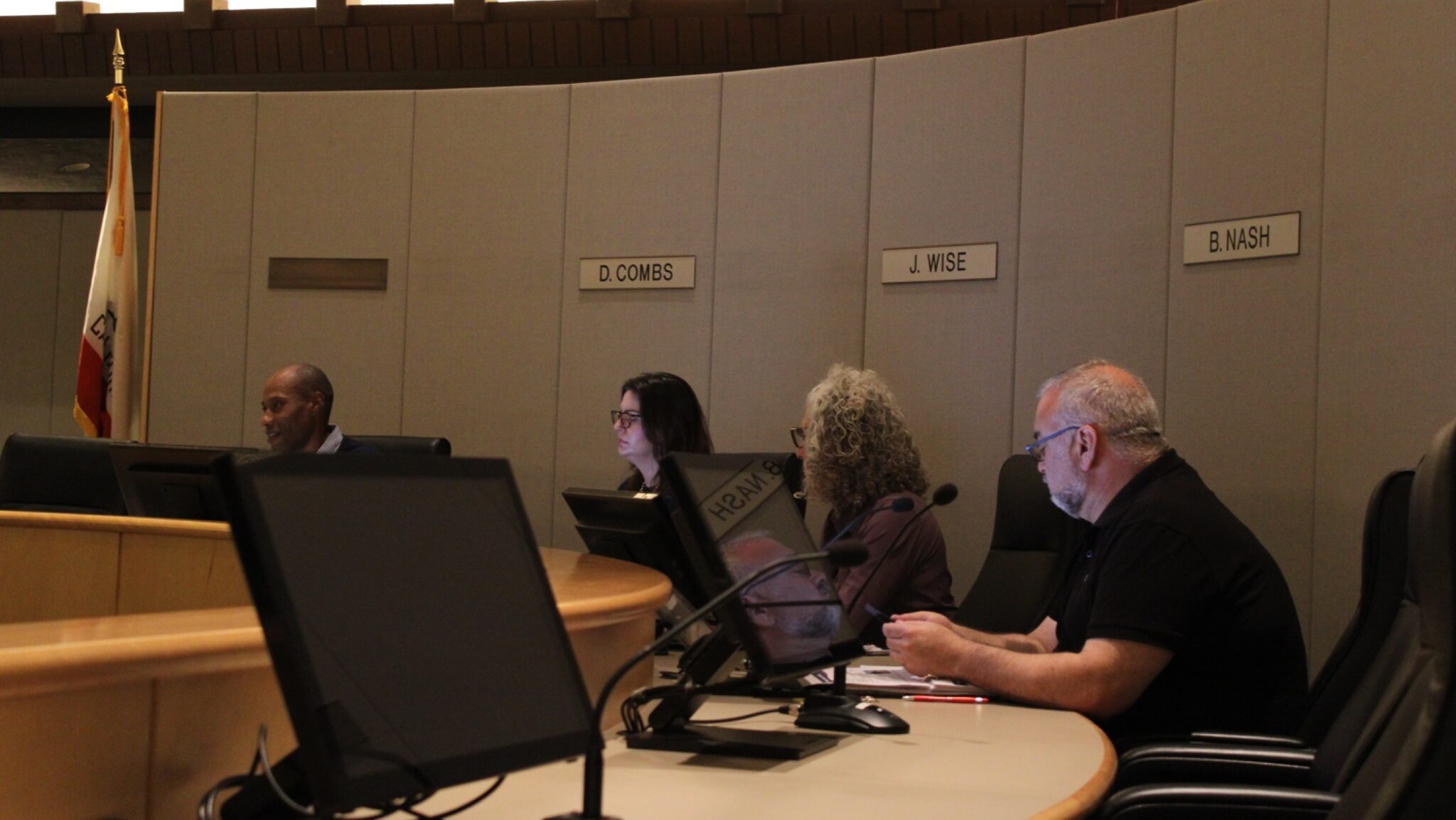
The Menlo Park City Council and community members shared their opinions about Lane Partners’ revisions to the Parkline Master Plan at the City Council meeting on Sept. 22.
The council held a study session about the project to be built on the current SRI campus, starting with Principal Planner Corinna Sandmeier giving a presentation discussing changes that Lane Partners has made to its development.
This proposal was originally approved in 2025, including 800 housing units and 251 below market rate. Additionally, it included up to 1 million square feet of nonresidential infrastructure, public open space, and roads for bicycles and pedestrians.
The revised plan increases the number of housing units to 1,082, with 294 below market rate. “Phase two would increase the number of housing units, consolidate office and R&D, add community-serving retail and restaurant space, increase office building heights, modify various project development regulations, revise the approved CDP BMR housing agreement, heritage tree removal permits, and vesting tentative map,” Sandmeier said.
Mark Murray with Lane Partners and Mark Schwettmann at Skidmore, Owings & Merrill also gave presentations discussing the specifics of this project.
During public comment, community members shared a wide range of perspectives on the proposal.
Kristen Gracia, the superintendent of the Menlo Park City School District, or MPCSD, shared that the project is going to be within MPCSD’s district boundaries. She mentioned that it could cause a 10% increase in total enrollment, and that she felt like the city hadn’t adequately addressed the impacts on the district.
Gracia urged them to bring the district in as the project continues to develop, consider students’ commutes when studying traffic patterns, and give MPCSD staff priority to below market rate housing.
“We value our partnership with the city, with Lane Partners, as well as other developers, and we’re ready to do our share. But a partnership means that school impact is on the table; it’s not in the margins, and school impacts are community impacts,” she said.
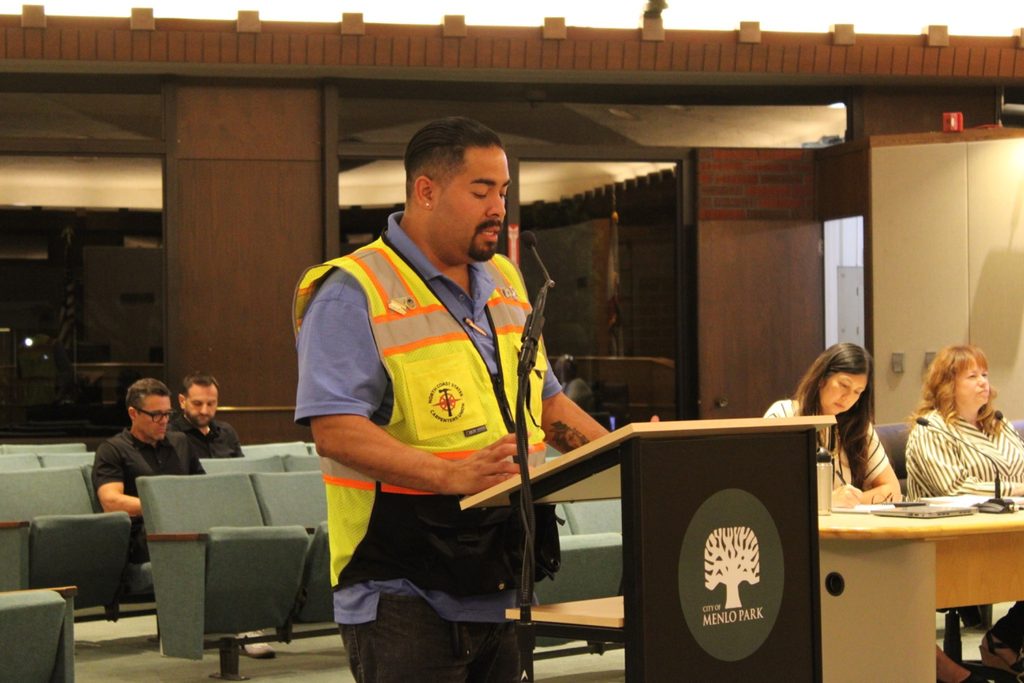
Nicole Gordillo and Oscar, members of a carpenters’ union, advocated for the city to consider the impacts of the development on workers. They emphasized the importance of choosing a responsible contractor that will care for its workers.
“Wage theft, misclassification, underpaid workforce are all too real. We can’t forget about the men and women who will be out there building these projects,” Oscar said.
They also stressed the benefits of an apprenticeship program and Gordillo shared her own experience attending one. “With opportunities like this, it helped me build a career and create a better future for my family and myself,” she said.
Another community member shared his concerns about the project’s planning, stating that it could cause Menlo Park’s population to increase by over 50%.
He was appalled by the lack of foresight and urged the city to mandate impact studies on the development. “Once that damage is done, it is irreversible. You carry a historic responsibility to act now and preserve 170 years of legacy for future generations. The dramatic growth being proposed demands rigorous strategic planning,” he said.
John McKenna, an environmental commissioner, expressed his support for the project but asked the city to consider its impacts on traffic and the destruction of heritage trees on the site. “I really appreciate that this project aligns with the city’s climate action plan in that it will be 100% all-electric construction,” he said. “I do feel like we might want to look at a way to ensure that that is the end result.”
Other community members praised the revised plans and how Parkline listened to community feedback. “The other thing I really admire about the way Parkline has been working on this project is the collaboration, the iterative response to community input,” Karen Grove said.
Others mentioned the necessity for more affordable housing in the area. “One sad constant thing for me has been that basically all of my friends who don’t work in big tech companies have had to move out of the area,” Brittany Baxter said. “I just keep thinking of how something like the townhomes or the smaller homes at SRI would be such a great fit for their situation.”
Council members expressed support for the updated proposal and echoed many of the same concerns as the community members.
Councilmember Jeff Schmidt stated that he wouldn’t be inclined to vote to approve any projects until a comprehensive transportation and circulation plan was created. “I’m asking to move away from the project by project view, and look at the reality on the ground of four or five major projects happening within a very short distance in the city. And a practical plan that we can bring to residents, as opposed to a master plan which is just a bunch of options and choices and guidelines,” he said.
Mayor Betsy Nash disagreed with his point. “I think it would be an incredible mistake to have anyone believe that future councils will not be approving projects until we get this information. To me, it is a very bad message to send and absolutely opposite to what we want to be doing,” she said.



First, why put our existing downtown at risk when Parkline can be designed from the ground up to meet HCD’s housing, infrastructure, and parking requirements of affordable housing without disrupting businesses or the character of our downtown. That’s why voting Yes on P is absolutely essential.
Second, the City needs to determine whether our schools can handle a flood of new students and assess the traffic impacts. This Council has a history of moving forward with major development projects without knowing the facts. We’ve all had enough of this. Do your homework first!
So far there is NO “Comprehensive Transportation and Circulation Plan”
I agree with Council Member Schmidt. Don’t vote on a developer or on “surplus land ” until you get that plan done and reviewed by the voters.
Councilmember
“Jeff Schmidt stated that he wouldn’t be inclined to vote to approve any projects until a comprehensive transportation and circulation plan was created.”
Vote YES on P to make sure this is approved y the voters, not just 3 council members!
Until the Menlo Park city council fully answers these questions, to my satisfaction, I must vote “YES” on Measure P.
1) Have you driven through All levels of the two Palo Alto parking ramps, mid day & mid week ?
I found them virtually empty above level 2 and below street level? (That is NOT a “Replacement” of the existing 5 acre surface lots!, as promised)
Note: Our convenient surface parking lots are, always, mostly FULL !
( They are obviously: NOT “surplus land” )
2) Have you walked downtown and asked the business owners AND the property owners if they oppose the city’s plan to disrupt (permanently) their parking lots?
Note: 125+ businesses signed a petition in opposition to the plan. Many stores have “YES on P” signs in their windows; AND there is Not one “NO on P” sign downtown!
3) Why vote to declare the fully occupied parking lots “Surplus Land” BEFORE the Yes on P and the lawsuits are resolved, if it will just results in the re-filing of the pending lawsuit, a cease and desist order, and more legal expense to the taxpayers?
4) Where will you get $20+to $45+ million for the Feasibility Report’s warning of a significant “Money Gap”?
Note: the realistic industry estimated cost of the ramp is double, resulting in a gap of $40+ to $90+ million!
Note: the city is already in a FINANCIAL DEFICIT!
5) Why give our 5 acres, our $50million parking lots, to a “PRIVATE” developer for $1/year?
Did you hire an appraiser to establish the annual rent?
(Industry standards would start at $500,000/ year with annual escalators)
How did you determine the rental rate? Who did it? This is a violation of the council’s fiduciary duties!
6) The parking lots were paid for by the adjacent store owners, through years of tax assessments, on the following promise:
In exchange for the taxes paid to establish the parking plazas, the adjacent property owners will have the right to a 51% vote before changes are made to the parking lots!
Why violate this Promise?
The city council has refused to answer these questions, therefore:
“YES on P” is necessary to STOP an unresponsive, out of control city council !
Michael DeMoss, Attorney and former member of the city of Menlo Park’s Finance & Audit commission.
I appreciate this work by the M-A Chronicle to share important community issues with our next generation of voters so they can be informed and engaged community members. Because it was a council study session, it was open to the public, recorded for future revisits, and accepted public comments on the matter. This is a big reason why I’ll be voting No on measure P. I think zoning is a complex decision and each project can and should take hours of background reading to fully understand. As an engaged citizen and informed voter, I don’t want to have to take that deep dive into local zoning decisions when I have an elected council rep to do that. And we’re a small enough community that I can reach out directly to my council member to talk about my concerns. I lose that ability when we toss these big decisions back out to voters. Then it’s just lawn signs and glossy fliers trying to influence voters who lack the spare time to dive into these issues.