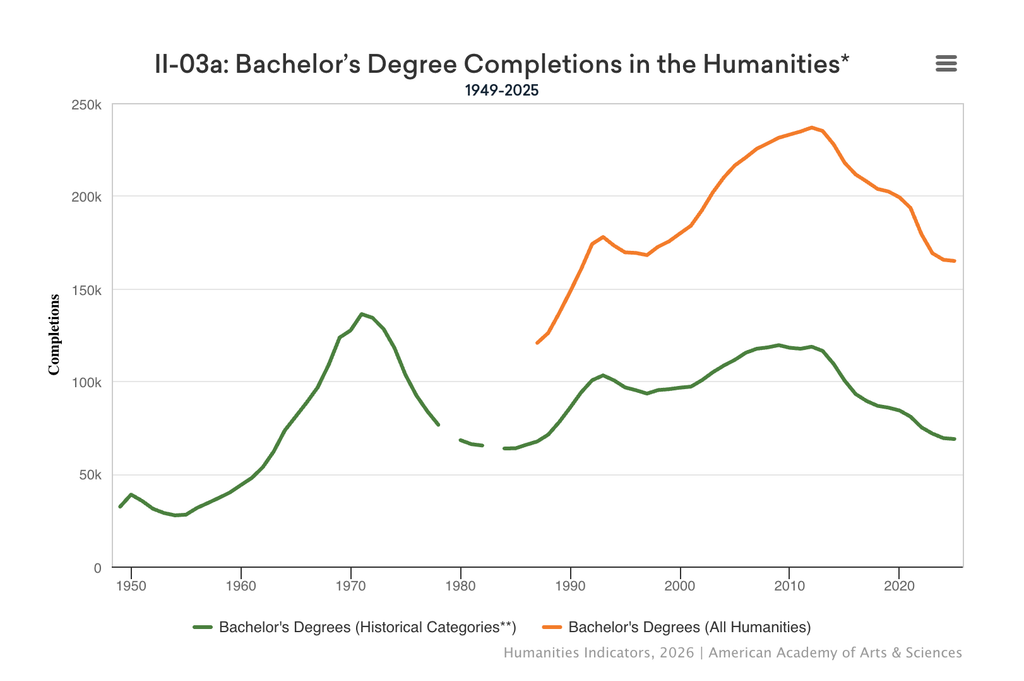
In 2025, the U.S. awarded the fewest bachelor’s degrees in humanities in 34 years, according to the American Academy of Arts and Sciences. This marks a 42% decline from 2012. Meanwhile, engineering, health and medical sciences, and natural sciences all saw increases in degree enrollment.
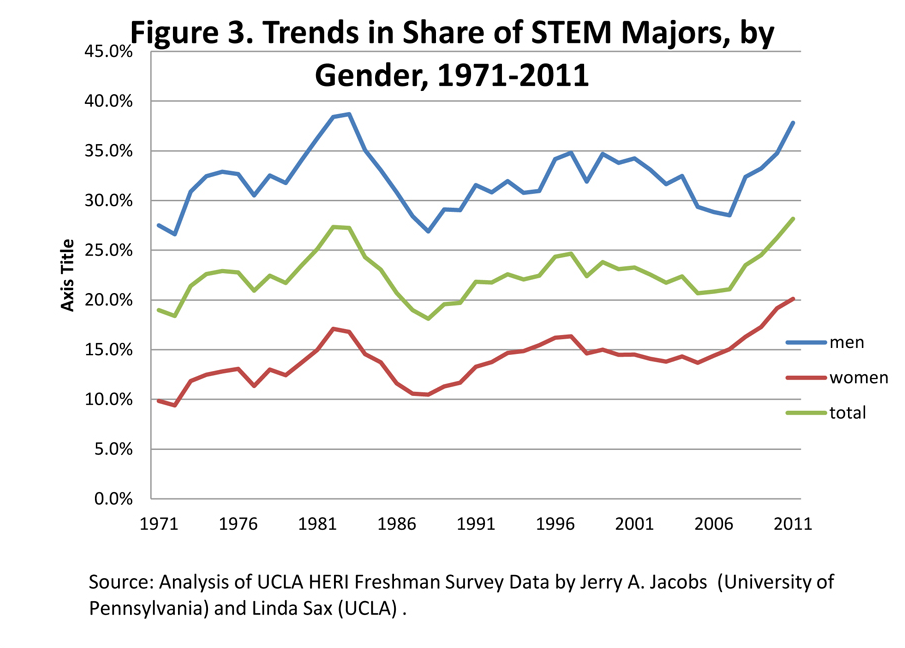
This pattern can be traced back to 2008’s Great Recession. Following the recession, students entering college prioritized choosing majors with more direct career paths, higher job security, and higher salaries, including engineering, technology, and health, with the pay starting at nearly six figures, according to CNBC. Students began drifting away from liberal arts and humanities education to adapt to the unstable economy.
“Practicality is a part of it,” senior Isabelle Habibi, who plans to major in data science, said. “Higher-paying jobs come from STEM majors.”
However, the threat of AI taking over STEM jobs has sparked doubts about these opportunities in the future. “Mathematicians have been waking up every day, and some of the hardest problems in mathematics have been solved overnight by these AIs, and they’re feeling disoriented because it’s their whole [livelihood],” Nicholas Taylor, a professor of English and Comparative Literature at San Jose State, said. “It is undoubtedly true that the starting salaries are lower for people with degrees in the humanities. The question that I have is how many [starting] high-paying engineering salaries [will] there be in 10 years?”
Some believe that it is more important for students to pick classes in subjects they genuinely enjoy. “When students get the opportunity and the funding and the support to study what they like and they’re good at, they tend to go on and have better and more fulfilling jobs and make more money,” Alexander Key, an Associate Professor of Comparative Literature at Stanford, said. “What’s going to make people successful in their future careers, earning-wise, is being good at what they do, and succeeding at it.”
But for students to have the opportunity and support to major in what they want, those programs need funding, which isn’t possible without enrollment. When students stop taking humanities courses, they must turn to budget cuts in those departments. Those cuts can lead to less specialized programs, and rising students are drawn to the better-funded STEM departments, widening the gap and creating a cycle.
“Faculty are allocated where the students are enrolled,” Taylor said. “So when a faculty member retires in my department, it’s harder to get permission to hire a replacement if the enrollment has declined.”
Students see a spread of these patterns to M-A, too. “I took AP Art History last year, and it was off and on the entire summer beforehand because just no one really signed up for it,” senior Grant Bennitt, who is planning to major in social sciences, said. “And this year they’re not offering it.”
Parental pressure also influences some students’ choices. “I think there’s a lot of focus on STEM just because we are in Silicon Valley, and a lot of parents push their kids more to take the higher math classes,” Bennitt said.
“When I reflect on [it], I realize my parents’ expectations [made me major in mechanical engineering],” English teacher Lisa Otsuka said. Otsuka originally majored in mechanical engineering before changing to a double major in Spanish literature and psychology.
Societal evolution plays a significant part in the equation. “The job market is changing so rapidly. I’m not sure that a STEM degree guarantees you a job either,” Taylor said. “A friend of mine is the chair of English at Stanford, and he said that for the first time last year, the number of computer science majors at Stanford declined. It had been increasing every year for a decade or more.”
Society is shifting its priorities. Trends adapt to fit the newest wants and needs of the people. Things popular twenty years ago might still be necessary today, but they’re not deemed as crucial as society picks and chooses what is. “Culture is changing,” Key said. “What the whole of the world agrees is the most important thing is changing all the time. Students make rational choices based on the culture and the information available to them.”
Right now, that culture, at least in Silicon Valley, points people toward STEM. At M-A, students speculate STEM classes and extracurriculars get prioritized more than others. “The robotics club really furthered my understanding and learning of mechanical engineering,” senior Julian Haddaway, who is planning to major in mechanical engineering, said. “We had enough funding to do whatever we really wanted to do.”
Inherently, humanities offerings don’t usually require the same scale of funding as STEM, as fewer expensive pieces of equipment are required for effective learning. Regardless, it still needs funding to keep programs.
Some feel that there’s a lack of effort in pushing humanities-focused students at M-A. While College Board provides more STEM classes, M-A still doesn’t have all the social science classes it does offer i.e. AP Government, AP Macroeconomics, AP Microeconomics. “There’s less of an incentive to take the difficult humanities classes, and I think at M-A that’s led to a lack of those AP classes that some students that are more interested in humanities take,” Bennitt said. “They’re offering a lot of AP STEM classes that are only challenging those types of students. They’re not challenging the more humanities-focused students.”
Silicon Valley’s fast-paced, tech-centered way of life also results in pressure on students to take more socially acceptable math and science classes. “It’s exacerbated in this area. There’s a rush culture here. Students will tell me if they’re not actively doing homework, they feel like they’re wasting time,” Otsuka said.
Whether it’s passion or salary, the economy and society are so unpredictable that current trends might be vastly different in a year or two.
Considering this changing climate, it is more logical to focus on your own wants than society’s. Many say what’s most important is aligning your education with passion—something you truly love. “You need to be committed to the work in and of itself. You need to actually enjoy it,” Key said. “University should be [something where] I can pick something that I’m interested in and really get into it. [And ask], why is the world like this?”
There’s no clear-cut solution to raising humanities enrollment rates. “Our hope is that humanities education will become more attractive, not less, as the AI revolution plays out,” Taylor said. “The data shows that there have been several studies [showing] that humanities majors are best prepared for situations of upper management, which involve a lot of ambiguity and uncertainty, and virtually no math.”