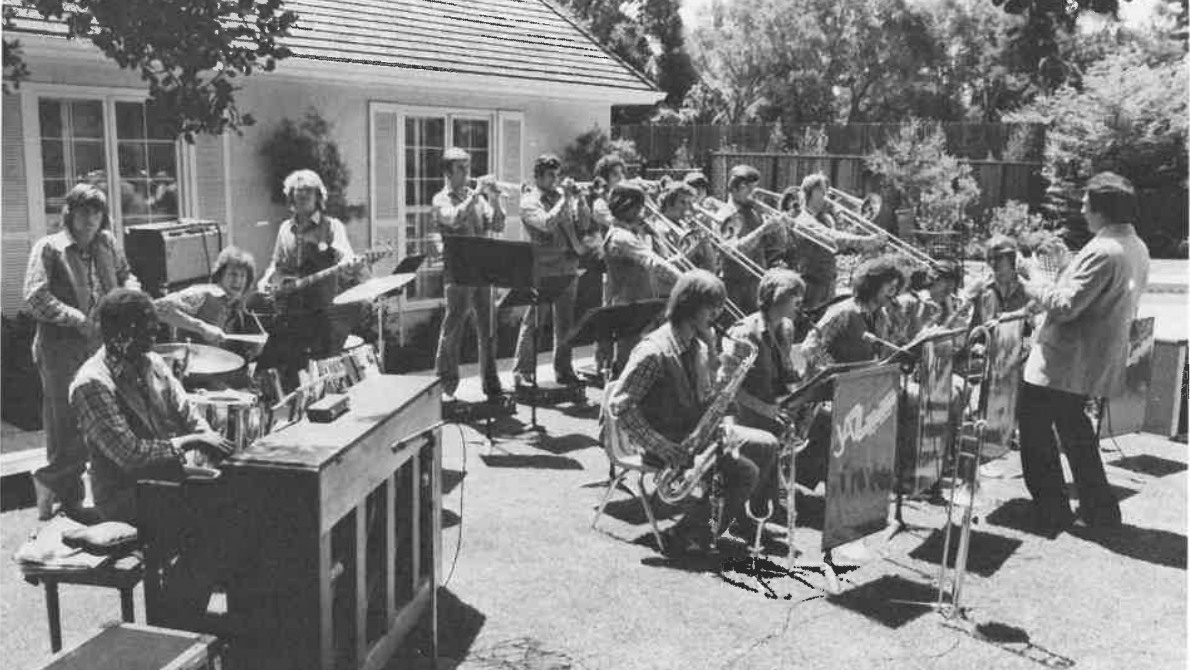
Most students have walked past Frank Moura’s name. Emblazoned in red on the concrete exterior of the music facility, it represents the legacy of a teacher who transformed M-A’s Jazz Program. Moura retired in 2010 after 39 years as the Music and Jazz Band Director, building a program whose influence extended far beyond the classroom walls.
Born and raised in San Leandro, Moura began playing trombone at age 6, and by the time he was 12, he was already performing with local symphony orchestras. He was offered scholarships to both The Juilliard School and San Francisco State University (SFSU). He chose SFSU because it was closer to home. After graduating from SFSU in 1968, he began his teaching career as a band director at Sequoia High School. Three years later, Moura moved to M-A.
Moura received permission from the principal, Doug Murray, to start a jazz program in 1971. “I decided to talk to the administration and I said I’d like to have a jazz band. They said ‘well, we’ve only got one kid signed up for it, but we’ll let you have the class with one.’ By the second semester, I had 18 kids in there,” Moura said.
Many of the students who joined the band had no prior knowledge of jazz. “We went to a few jazz festivals because I wanted them to hear bands. The first one we went to was Rio Vista. I can still remember walking out on the stage and sitting there, and starting the band. And when we were done, only one person in the audience clapped, and I was so embarrassed to turn around and bow,” Moura said.
Moura then took the band to the Reno Jazz Festival in order to let the students hear high-level bands play. “The top score was 100 in those days. We got 29,” he said.
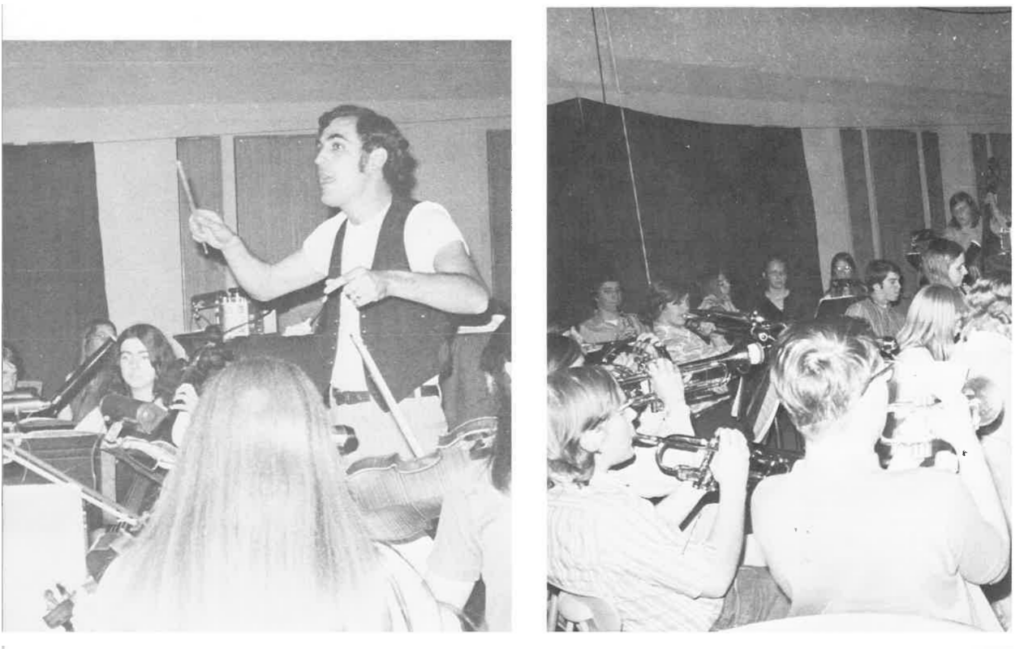
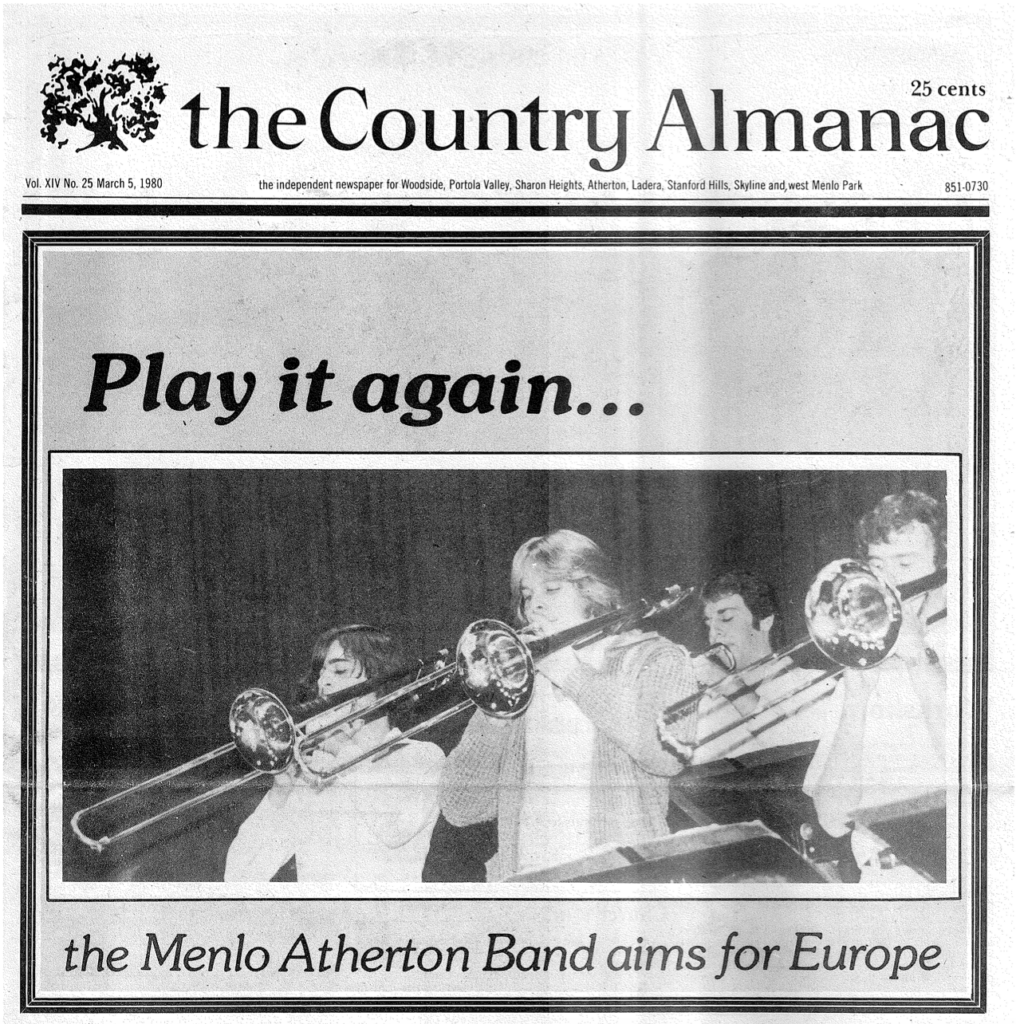
As years passed and the program found its rhythm, the students and jazz band saw massive improvements. In 1978, M-A’s Jazz Band won the Reno Jazz Festival. “The following Monday after we won the festival, the people who ran the program called up and said, ‘We’d like you to come with us to the Montreux Jazz Festival in Switzerland,’” Moura said.
However, the band lacked the money to support a trip to Europe. After a $2,500 donation from Frank Sinatra, along with other contributions, the band was able to make the trip. “I found out later that we were chosen as the best amateur band at the Montreux Festival,” Moura said.
Over time, Moura built the program into an internationally recognized ensemble. That legacy lives on in the posters of past performances on the music room walls and the trophies on its shelves. In total, throughout Moura’s career at M-A, the Jazz Band traveled to Europe 12 times.
Bill Flaherty, M-A’s current music director, sees these artifacts as part of Moura’s lasting legacy. “Most people who come into the band room notice a few things: trophies, lots of trophies. But then they notice all the posters hanging on the wall. So I think one of Frank Moura’s more enduring points of legacy is from that period of time—by which I mean the 80s through the early 2000s,” he said.
Bill Smolik, ’02, went to Europe three times. “The Europe trips are honestly some of the more memorable moments of my life. I was able to see some absolutely amazing groups,” he said.
While the Europe trips gave students experiences that stayed with them long after high school, the Jazz Band also became an important source of community and belonging. “The band had a sense of being in it together. It was one of those shared, difficult but rewarding experiences that I don’t think is super common in many other classes, and so it definitely felt like a family,” Smolik said.
At the height of Moura’s tenure, the jazz program expanded to three jazz classes, with M-A’s Jazz Band attending dozens of festivals and recruiting many students.
“[Moura] was very energetic, and he was very active in getting students into the program and finding students for the program,” Flaherty said.
Gordon Fels, a professional jazz musician and local jazz teacher, highlighted Moura’s resourcefulness. “There’s a community down there where there’s a lot of big Tongan guys, and Pacific Islanders in East Palo Alto, and what Frank would do was take these guys and turn them into low brass players, such as the tuba. You need big people sometimes to play bass trombone and tuba, and so Frank was very resourceful,” Fels said.
“I would usually go around and find kids who were interested in being in the band, but weren’t good enough to make it on saxophone or trumpet, and I gave them the bass trombone,” Moura said. “ There were probably eight kids who were not trombone players, and four of them won outstanding musician awards at festivals knowing only eight notes.”
In part, Moura’s success stemmed from his ability not only to understand his students but also to mold and adapt the program so that everyone would thrive. “He had a good way of picking songs that were excellent jazz tunes, but not exclusively jazz. You have a fair amount of Spanish-speaking kids at M-A, and so he would choose some Latin music. He just knew how to relate to the kids,” Fels said.
By the late ’90s, the M-A Jazz Band had built a reputation well beyond the Bay Area. By 1998, the band had won 75 jazz festivals and was regularly traveling to some of the highest-acclaimed jazz festivals in the world. They even went international, frequenting the Montreux Jazz Festival in Switzerland and the North Sea Jazz Festival in the Netherlands. “Frank Moura had, arguably, the best high school jazz band in the entire country,” Flaherty said.
Those international stages put M-A students in the orbit of some of jazz’s biggest names. They performed alongside world-class American jazz artists such as trumpeter Dizzy Gillespie, vocalist Ella Fitzgerald, and saxophonist Stan Getz. The band’s international presence continued into the 2000s, with performances at the San Sebastián Jazz Festival in Spain, where they played music by major bandleaders including Duke Ellington, Count Basie, and Stan Kenton.
These trips to Europe not only established the Jazz Band as prominent but also provided important learning experiences for the students. “They learned to work as a unit and put aside their egos to play and they took care of each other. It was a really good learning experience because a lot of these kids were in the program for all four years, but a lot of them were in the Jazz Band for two or three years, and so they knew what to do. And by the middle of the trip, the band’s playing was close to professional,” Moura said.
More than anything else, it was Moura’s quirks and funny phrases, affectionately called “frankisms,” that made him stand out as a teacher. “I started saying to the band, ‘you got to squeeze the juice out of the music,’” he said. “One day they were just playing disinterestedly, and so I said to them ‘don’t just play the notes, squeeze the music.’ Eventually I got so upset with them I reached into my lunch bag and there was an orange. It still had the skin on it and everything. So I bit it, and then smashed it on my forehead, squeezing the juice and it came dripping down my face.”
Moura’s frankisms tie back to his teaching philosophy. “People are young, and they’re developing from being a kid to being an adult, and you see great growth, especially by their senior year,” he said. “You’ve got to somehow draw their attention to what you’re doing and what you’re saying because they’re the ones who’re going to play, not me.”
According to Fels, Moura’s passion for music and his ability to connect with students were central to his effectiveness as a teacher. Jazz required students to improvise, to stand and play something unique on the spot. Doing so required confidence.
“The main thing was the love for the students and building their love and showing them how possible and fun it was. Kids have to believe that they can learn the trombone, and actually taking an improvised solo takes a lot of courage,” Fels said. “He provided the students with warmth, welcome, and courage, and of course, the musical information. He was perfect for it.”
“He’s just a really nice guy, super generous, funny,” Flaherty said. “He’s got a ton of funny stories from his time in the band.”
Moura’s influence extended beyond the students in his jazz classes. Founded in the mid ’70s by trumpet player Steve Namius, M-A has been home to Tuesday Night Live, a local jazz group made up of doctors, Stanford professors, and professional musicians who meet every Tuesday evening to rehearse. Joining the band in 1991, Moura was not one of the group’s founders, but he became an important part of its connection to M-A.
This connection between M-A’s jazz program and the wider musical community continues today. Smolik now plays the trumpet regularly with Tuesday Night Live. He is also a trumpet coach for the Jazz Bands at M-A.
Moura now even plays with his former students. “It’s fun. I took them seriously, and they took themselves seriously, and as time passes, they improve. They were good in high school, and they’re better now,” Moura said.
One of the things Smolik misses most about being one of Moura’s students was being part of his passionate energy. “Honestly, it’s just being around that energy. I get to see him basically weekly now, which is a huge privilege and one of the main reasons I play with Tuesday Night Live,” Smolik said.
The path from M-A Jazz Band to Tuesday Night Live reflects the kind of community Moura created. One that can last far beyond graduation. “People who are in bands together, they are just friends for life,” he said.
For some former students, music became more than a serious hobby. Smolik is now a professional musician and teacher. Mark Lettieri, ‘01 musician, is now a Grammy-winning guitarist and member of the renowned jazz-fusion band Snarky Puppy.
For Flaherty, preserving Moura’s legacy does not mean recreating the past. It means keeping the program alive as the school and its students change.
But over time, the heart of the program remains. “I hope above all that they carry with them a love of music and a love of jazz,” Flaherty said.
Listen to M-A’s Jazz Ensemble Perform at Jazz in the City in 1987.