6/10
The Drama, the fourth feature from writer-director Kristoffer Borgli, is A24’s fifth release this year. Coming off a highly successful year (think Marty Supreme), the film seems to be the independent studio’s first real star vessel. The film stars A-listers Robert Pattinson and Zendaya as a young Boston couple going through pre-marriage anxieties (to say the least). Alana Haim, Mamoudou Athie, Hailey Benton Gates, and Zoe Winters accompany them in supporting roles. Though it’s been marketed as a romantic comedy, and Borgli describes himself as resistant to genre, the film is, unsurprisingly, a 1970’s esque capital-D Drama.
The Drama is two films in one. The first, an incredible, well-paced dark comedy spurred by an amazing performance by Pattinson and a gut-punch confession. The second is slower, smaller, and weirdly safer. It tackles some pretty deep questions. Then it totally ducks answering any of them.
The Drama starts with a meet-cute: Charlie (Pattinson), a British curator at the fictional Cambridge Art Museum, spots Emma (Zendaya) reading at a coffee shop. He slyly takes a photo of her book, Googles the synopsis, and ambushes her with a SparkNotes fake-it-till-you-make-it-pickup line. It works. They chat, she lets the shallowness slide, and they fall in love. It’s textbook.
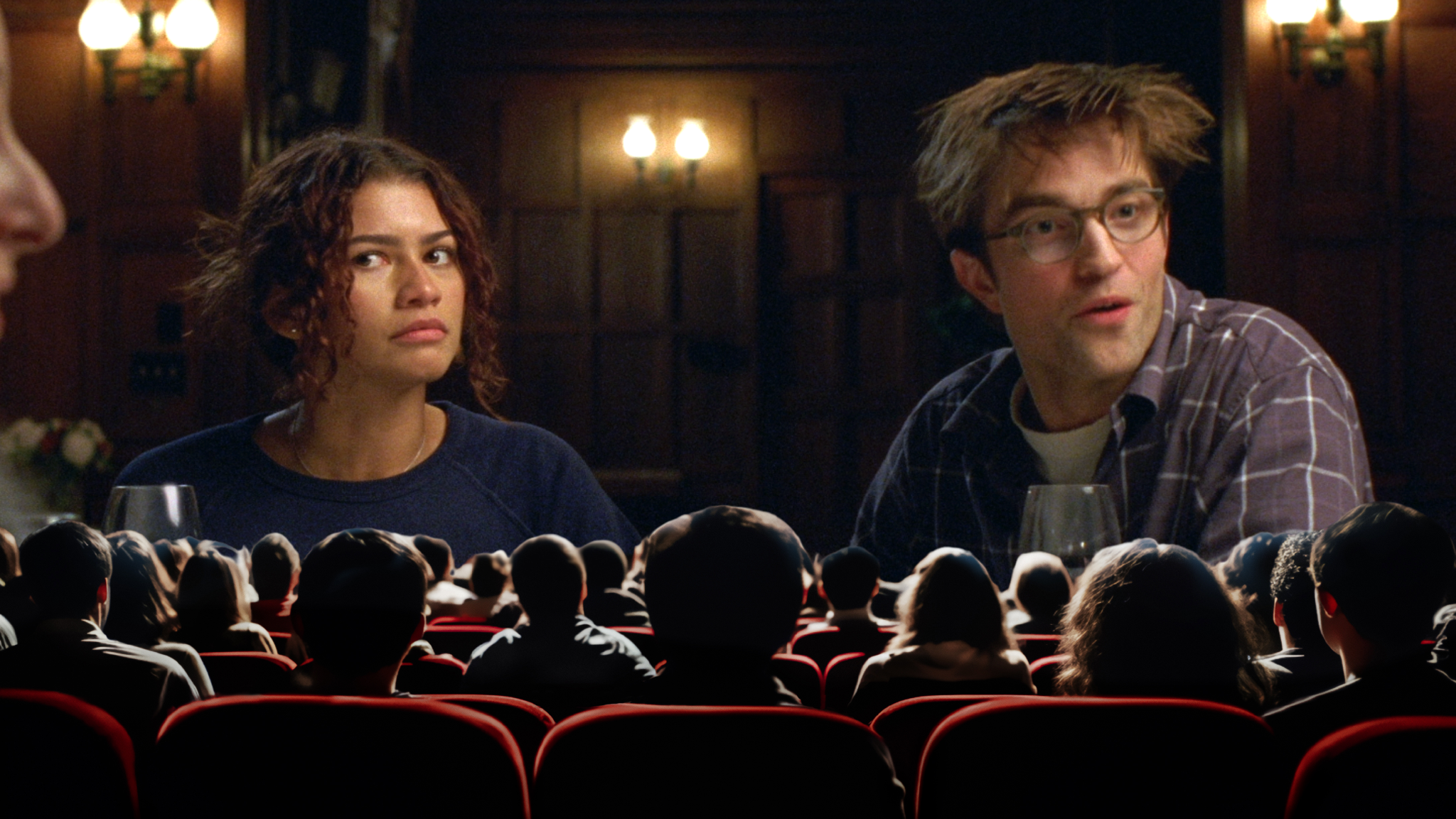
Cut to a week before the wedding. The happy couple is at a wine tasting with well meaning best man Mike (Athie) and overbearing maid of honor Rachel (Haim). Rachel suggests a party game: go around the table and name the worst thing you’ve ever done. Charlie cyber-bullied a classmate into moving towns. Rachel locked a neighbor with an intellectual disability in an RV (don’t worry, she insists he survived). Mike used an ex-girlfriend as a human shield against an attacking dog. Now (spoiler alert!), it’s Emma’s turn.
She confesses that at 15, she planned and almost carried out a school shooting. Even worse, Emma only backs out after another shooting happens in the same town, leading to a change of heart. Everyone goes silent. Whoops.
The next hour of the movie is unnervingly slow. Charlie spirals: Should he go through with this wedding? Can he marry a person like that? Emma—who, after her epiphany, spent years as a gun violence advocate—gets cast as a monster by her closest friends. Besides questions of loyalty and trust in relationships, The Drama is about something deeper. Who gets forgiven and who doesn’t? And who gets to be certain about where they draw their own individual line?
It’s a master showing by Pattinson, who, even counting his complicated roles in The Batman and Mickey 17, can call The Drama his biggest challenge yet. He’s pretty exceptional by any standard. He manages to unravel throughout the film. He starts as bookish, flustered, and quietly charming, but shrivels into a bedheaded, bloody mess covered in a shroud of doubt. Charlie’s clumsy third-act pass at his colleague Misha is more embarrassing than angering.
Zendaya gets significantly less screen time. Though Emma is meant to be the moral center of attention, the film keeps much more to Charlie’s head. Emma is just not given enough to do. She’s relegated to the corner. That said, with what she does have, she handles fairly well: she’s quiet, watchful, and ashamed. She’s reserved without ever coming across as too cringy or annoying.
The script is perfectly acceptable as well—the first half has some genuinely funny jokes and piercing dramatic tension, though the second half edges on cringe humor and odd timing more than true comedy. Visually, the film is doused in austereness: cold museum interiors, 19th century stone homes, and perfectly staged dining tables. It’s complemented perfectly by a well-timed flute-based score, too.
Granted, the film’s superb premise gives Borgli room to explore new ideas. The movie has a genuinely new angle about relationships: how far can someone’s past go before it poses a problem for the future? It demands critical thinking and deep thought. Then, the movie sort of abandons what makes its whole premise interesting.
Take the group’s other confessions, for instance. They sit there the entire film, untouched. Charlie ran a kid out of his hometown. Rachel left a child to spend the night alone in an RV. Mike sacrificed his ex to the dogs. Still, Borgli refuses to bite. The other characters choose to pile on Emma, leaving us to chase the point.
There’s a much sharper movie inside The Drama. One about how every person at the confession table is a hypocrite. Instead, we get an oddly-timed brawl, and a final scene where Charlie and Emma sit at their favorite restaurant, smile from across the booth, choose to start again, and the credits roll. It’s not a complete letdown, but it just feels like wasted potential.
By the time Charlie crawls into the dinner booth during the film’s final scene, bruised and tuxedoed, there’s been a failed wedding, some failed friendships, a broken relationship, and probably some broken tables too. There’s also been some exquisite acting by two of the world’s finest superstars. Too bad The Drama doesn’t know what makes it interesting, or dramatic.