
Following the unanimous Board decision to close TIDE Academy on Feb. 4, a group of TIDE parents filed a civil rights lawsuit with the U.S. District Court of San Francisco under the name TIDE Rising. The parents sought a temporary restraining order (TRO) against the Sequoia district to prevent the school’s closure for the following year. Ultimately, their request was denied in a March 5 court hearing presided over by Trina L. Thompson, and since then the District has filed a motion to dismiss the case entirely.
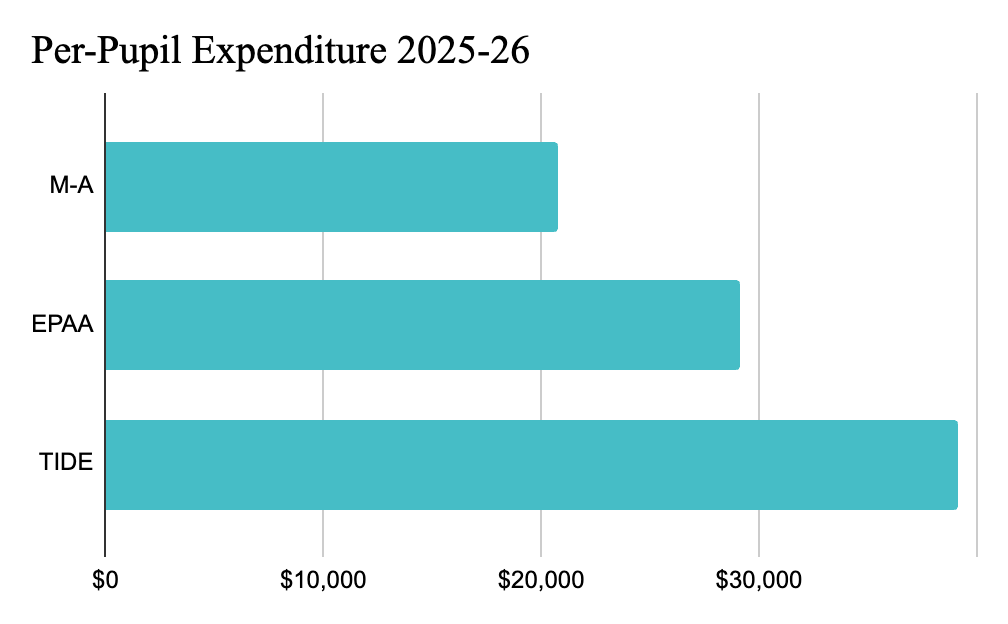
The Board attributed their vote to close TIDE to its towering programming costs, declining enrollment, and contribution to the District’s increasing spending deficit. In the 2025-26 school year, the District spent $39,169 per TIDE student, surpassing other schools’ per-pupil cost and almost doubling M-A’s.
In the lawsuit, Leigh Law Group argues that the decision to close TIDE violates Title II of the Americans with Disabilities Act and Section 504 of the Rehabilitation Act, both of which prohibit discrimination against individuals with disabilities in programs, services, and activities. They claim TIDE’s accessibility cannot be replicated at a more comprehensive public school in the District. Consequently, they argue that closing TIDE unjustly robs students of the school’s unique suite of accommodations and support.
According to TIDE Rising, the school’s success lies in its size. “From its inception, TIDE was positioned and marketed by the District as the small-school alternative within a district of large comprehensive campuses—the school where students who could not function in the 2,000-student environments would be sent and could succeed,” the lawsuit reads. “Its own staff counseled families of struggling students to enroll at TIDE rather than remain at campuses where those students were failing.”
With roughly 37% of its students having a disability, TIDE makes the high school core curriculum accessible to neurodivergent students who may struggle at large schools. TIDE also boasts the largest A-G completion rate of students with disabilities. “The difference was not the 504 plan—it was the environment. TIDE saved my child’s future,” one parent said.
TIDE Rising claimed that the Board failed to consider less discriminatory options before choosing to close TIDE. According to the lawsuit, eliminating eight District office administrative positions could save the same amount of money as closing TIDE. “The District chose to close the school serving 37% students with disabilities rather than reduce central office staffing, without any analysis of why the option that eliminates an accommodation for students with disabilities was preferable to the option that does not,” the lawsuit states.
Additionally, the plaintiffs noted a lack of transparency on behalf of the Board amid their decision-making process. In November, Superintendent Crystal Leach “explicitly stated that finances were not the reason for considering closure,” however, by January, “the District had shifted its justification entirely to financial considerations,” according to TIDE Rising. Furthermore, the school’s closure might increase costs for the District—in extreme cases, students who cannot succeed at a comprehensive school require Non-Public School placements, which begin at $75,000.
TIDE Rising also maintained that the District’s decision to close the school was predetermined. “It was a pre-scripted communications exercise,” the lawsuit reads. In documents acquired by a Public Records Act request, communications with McGowan Impact Consulting, an external consultant company, were revealed. The firm produced a “Communications Workplan” for the Board, encompassing “draft talking points, draft parent emails, and a pre-set milestone timeline culminating in a ‘Board Meeting — Findings & Possible Vote.’”
Communications with this consulting firm occurred before the trustees assured the public that their decision would be made publicly. The plaintiffs cite an instance in which Trustee Mary Beth Thompson received an email from a TIDE parent describing their student’s achievement at TIDE, which Thompson forwarded to Leach with the description, “FYI. I’ll see what the consultant writes and then use it to draft something here, then send that along.” The plaintiffs argue that the Board’s seeming commitment to public engagement was a front to quell the retaliation of TIDE parents, students, and staff.
In the District’s motion, which requested the judge to deny the TRO, the defendants argued that Title II of the ADA and Section 504 do not permit “the right to freeze a school closure decision or to require the District to preserve a specific campus and institutional model.” They also mentioned that the District is legally obligated to satisfy the needs of students with IEPs and 504 plans at any campus.
The defendants also claimed that TIDE “was not designed, approved, or designated as a therapeutic or special education campus, and it does not operate as a specialized placement for students with disabilities.” They maintained the plaintiffs’ notion that TIDE students will be harmed by moving to larger campuses is “speculative and forward looking, and that speculation is not irreparable harm.”
The defendants also received a declaration from the District’s Executive Director of Special Education, Ilja Van Laar. Van Laar claimed that disabled students’ needs can be adequately fulfilled across the District, and that nothing about TIDE’s setting distinguishes its special education supports from other schools in the District.
In addition, the District argued that a TRO would disrupt the status quo by suspending districtwide planning and redirecting resources back to TIDE. According to the motion, it would “leave teachers and classified staff in limbo, delay hiring and reassignment decisions, and impair the District’s ability to finalize schedules and allocate resources for all campuses.”
Furthermore, in a declaration for the defendants, Leach stated that the district had already reduced staff in response to their financial strain. This undermines the plaintiffs’ point that TIDE’s closure was the District’s only course of action to mitigate their spending deficit.
During the March 5 court hearing, T. Thompson refused to grant a TRO obliging the District to halt the closure of TIDE Academy. She acknowledged TIDE’s unique circumstances but stated that her decision came down to the plaintiffs’ inability to prove that harm was imminent, and the District’s fraught financial situation.
On March 6, the District filed a motion to dismiss the parents’ complaint. The motion will be heard on May 5 In San Francisco Superior Court, in Courtroom Nine on the 14th floor.