


In nearly 40 years, the Tinsley program has bused more than 5,000 children out of East Palo Alto (EPA) to attend schools across the highway. In the same period, it has brought two students in.
The Tinsley Voluntary Transfer Program, the country’s first inter-district desegregation plan, was supposed to run both ways. It never has.
Margaret Tinsley, who would lend her name to the program, raised her family in EPA, and through the 1960s and 1970s, she watched the Ravenswood schools come up short, one child at a time.
Tinsley’s eldest daughter was bright enough that the school had her helping her classmates instead of learning herself. She even skipped a grade. Her son’s elementary school shut its doors over falling enrollment. When he made it to junior high, the district couldn’t keep its classrooms staffed.
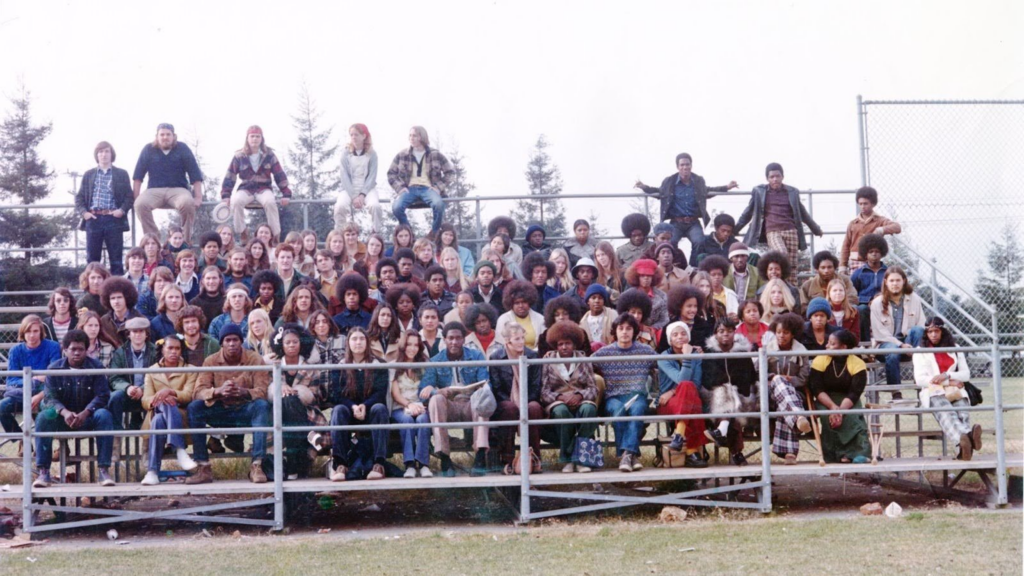
“They were having difficulty getting teachers hired,” Tinsley said. “I think at one point they were hiring them in from Texas.”
She believed her children weren’t learning what they should have been at their grade levels. She wasn’t alone. In 1976, Tinsley and roughly 170 other EPA parents sued the state of California and nine surrounding school districts.
“I believed in a better education for my kids, so I joined in,” she said. Per the lawsuit, the goal was simple: erase district lines. It argued that the boundaries drawn around Ravenswood restricted Black and Latino students inside an underfunded system while wealth pooled in districts like Las Lomitas or Palo Alto Unified. The solution was redistricting: consolidate Ravenswood and its affluent neighbors, Palo Alto Unified and Las Lomitas among them, into one district where resources could be shared equitably.
For the parents, many of whom had spent years petitioning the district for changes, the lawsuit was a way to force the issue.
“Maybe this was a kick in the pants to say, ‘Okay, if you’re not doing what we feel needs to be done, then we’re going to try another path,’” Tinsley said. “My kids [were] getting older and older, and needing their time to be better than it was.”
For 10 years, the lawsuit stayed in the courts. In 1986, worn down after years of legal battles, the parents settled for something far narrower than redistricting. A lottery was to be created, where a fixed number of Ravenswood students could transfer out to a wealthier district each year. Students from those wealthier districts could also transfer into Ravenswood. In the program’s history, however, only two have done so.

Importantly, the borders for the districts stayed. Palo Alto kept its wealthy tax base. So did Las Lomitas. It was the dream outcome for the richest districts—they kept most of their money while appearing more diverse.
“I can’t say that’s what I sued for.”
Margaret Tinsley, on the settlement that now carries her name
How the Tinsley Program Works
The mechanism is simple: each year, up to 135 minority students entering Kindergarten through second grade are given the opportunity to enter a lottery to transfer out of Ravenswood. Palo Alto Unified takes the largest share of the outbound students at 60, followed by San Carlos, Menlo Park City, Las Lomitas, Portola Valley, and Woodside. The transfer program lasts from Kindergarten all the way through the end of middle school.
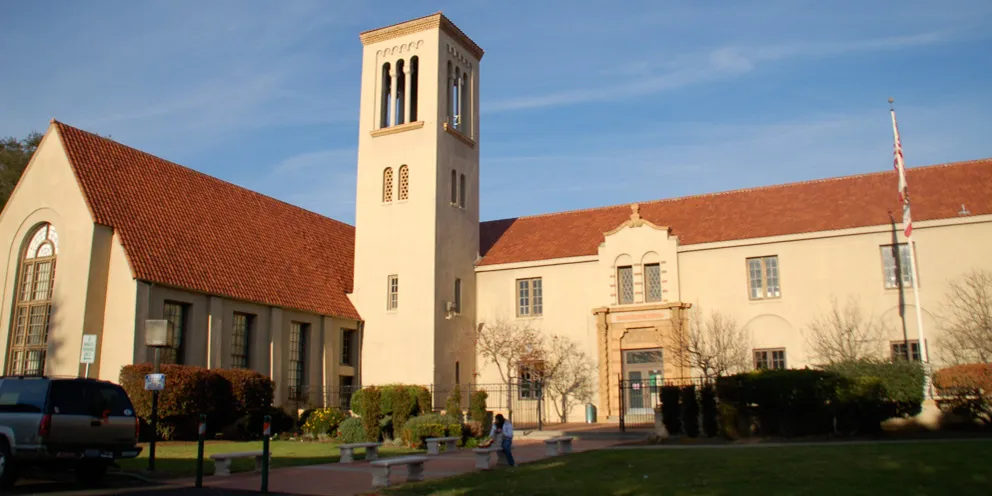
The opportunity doesn’t come with a particularly short commute either. Students often wake up at 6:30 a.m. and embark on a long bus ride across district lines.
Why It Has Failed
The program has failed in two ways. For the children it moves, the gains are real but small—released test data and a Stanford study show lottery winners and losers scoring almost identically—and tend to flow to academically motivated families who would have likely excelled regardless. For the district they leave, the cost is heavy and shared: Ravenswood loses its most engaged students, meaning the children left behind inherit a poorer, less engaged environment. This can lead to a self-defeating cycle where lower overall test scores and a worse reputation cause more parents to seek school elsewhere.
The settlement gave wealthy districts a way to respond to legitimate calls for desegregation without ever redistricting. This was by design.
Importantly, Tinsley was not just an innocent byproduct of these problems. The settlement made choices, and some were avoidable. One provision in the settlement called for the creation of a public high school in EPA. None was ever built. Two of the settlement’s three goals—improving Ravenswood’s achievement and increasing cooperation between districts—were vague enough that districts could just ignore them. The only part that endured was the easiest: the transfer program.
The settlement gave wealthy districts a way to respond to legitimate calls for desegregation without ever redistricting. This was by design.
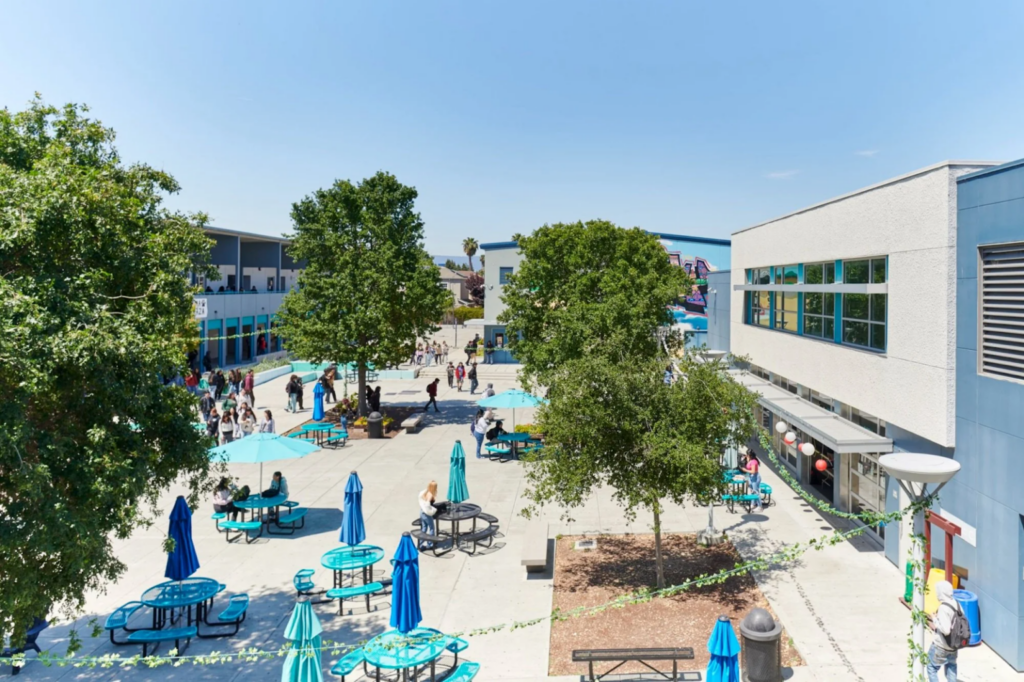
It is also worth conceding what a transfer program was never meant to do. 135 spots were never going to reverse decades of redlining, a freeway that walled East Palo Alto from Menlo Park, or gradual gentrification with the growth of big tech in the area. Anyone expecting the lottery to fix Ravenswood’s academic challenges was expecting too much of it.
The Data
Although anyone can apply, the students who apply to Tinsley are not the average student. Applicants to the Tinsley program already noticeably outscore Ravenswood students who never apply. The program tends to draw the families with the most time, resources, and information.
At first glance, results of the program are impressive. Released data indicates that Ravenswood is one of California’s lowest-scoring districts, with about 7% of students meeting the state math standard in 2023-24.
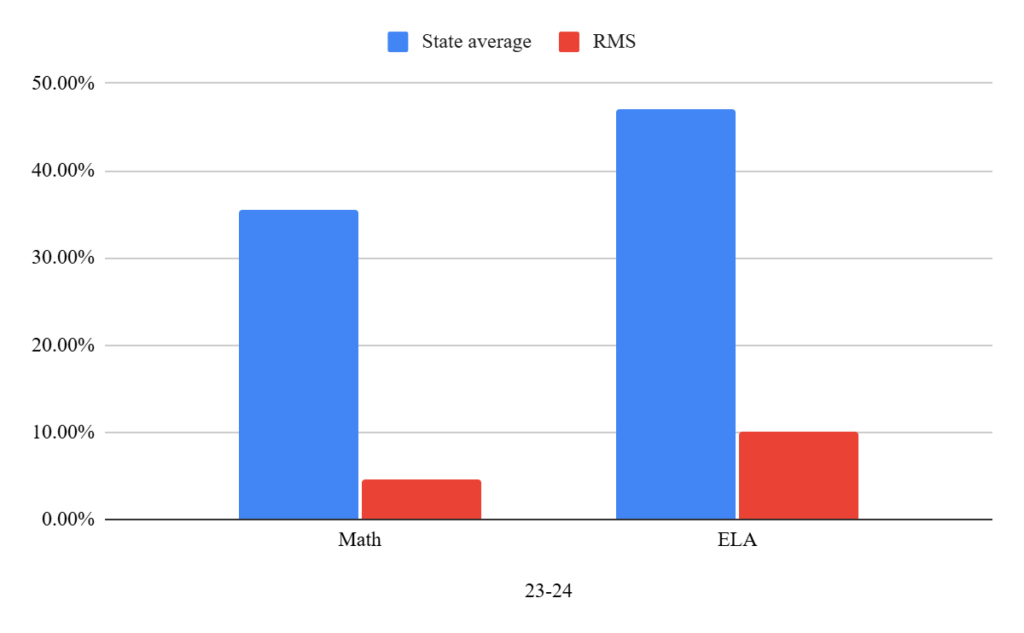
Tinsley students perform noticeably better: around 28% of Palo Alto Unified’s Tinsley students met the math standard.
As a result, when the data shows that Tinsley-accepted students perform better on tests, it is unlikely to be the result of the program. Kendra Bischoff, a sociologist now at Cornell, isolated the effects of the program in her 2011 dissertation by comparing lottery winners against applicants who lost—the children of equally resourced and involved parents. The result is that students who applied to Tinsley but got rejected performed nearly the same on Math and English when compared to Tinsley-accepted students. Scores in Science and History for Tinsley-accepted students were only marginally higher.
Much of the gap between Tinsley students and their Ravenswood peers is not the program lifting children. It is that the families who apply were already ahead of those who don’t.
Students who applied to Tinsley but got rejected performed nearly the same on Math and English when compared to Tinsley-accepted students.
The loss, on the other hand, is significant. Ravenswood’s enrollment has fallen from about 4,550 students in 2008-09 to roughly 2,500 today, a drop of over 40%. Though gentrification and charter schools are the clearest culprits for that decline, the Tinsley program is certainly a part of the problem. Since 2008, the share of Ravenswood students who are low-income has climbed from 85% to 92% while test scores have mostly been stagnant. Modest improvements in scores last year, credited to the new Ravenswood Promise initiative, are underwhelming for a district that spends upwards of $40,000 per student, double the state median. Ravenswood has not only become smaller after the Tinsley program. It has become poorer.
Even though admission is determined by lottery, the program draws the most motivated students with the most involved parents. Remove them, and what’s left is a school of even more concentrated poverty and on average, less motivated students.
Sean Reardon, a Stanford professor of sociology, explored this phenomenon in his research. His findings indicate that the single strongest predictor of achievement gaps is the concentration of poverty, and that high-poverty schools, on average, perform worse. Put simply, one of the most important factors in a child’s education is who their peers are. Students who have poorer, academically less strong peers tend to match that academic level and perform worse.
The Student Cost
Most Tinsley students like the program. There’s a sense that it’s an opportunity and privilege they shouldn’t squander. There’s one apparent problem, though. Which students are satisfied with it?
Tinsley alum Marco* has few doubts about the program. “[My favorite part] was definitely the group of people that I met because of it,” he said. “I don’t think I would have been friends with them or as motivated in classes without the Tinsley program.”
His parents drove him to band concerts, and wherever else he needed to be, including the nearly 40-minute drive to school every morning.
La Entrada seventh grader Daniel* shared a similar positive outlook. “If I went to school in East Palo Alto, I would be doing worse,” Daniel said. “They pay more attention to us than at the East Palo Alto school.” Daniel’s parents come to all his basketball games and drive him home when needed.
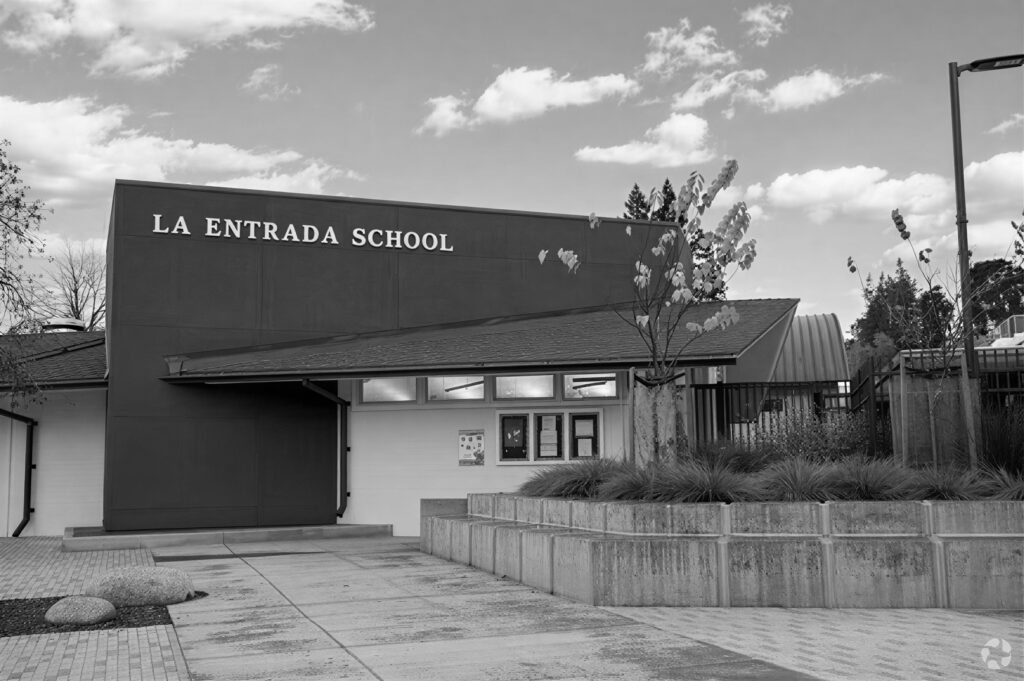
Marco and Daniel have something in common. The students most sold on the program are the ones whose parents can drive them instead of taking the bus and who can show up to their extracurriculars. M-A Study Skills teacher Karina Flores, who was part of the program herself in the 1980s, names the commonality outright.
“In order for students to be successful in the Tinsley program, there has to be a lot of parental involvement,” Flores said. “That was the game changer.”
So, “the kids love it” is not a rebuttal. The program works best for the most well-equipped families, and for those who would likely succeed anyway.
“In order for students to be successful in the Tinsley program, there has to be a lot of parental involvement.”
Karina Flores
For students who lack that cushion, the problems with the Tinsley program become clear. Andre* described how riding the bus singled him out.
“If you’re on the bus and you’re from EPA, it’s obvious you’re from Tinsley,” Andre said. “As soon as they see you on that bus, they assume you’re from Tinsley.”
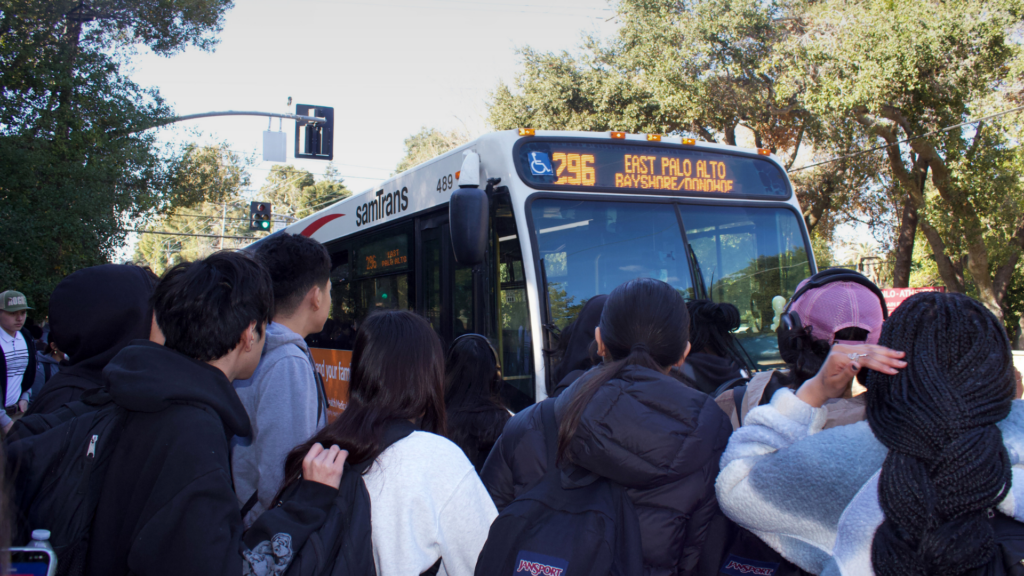
Most of Luis*’s friends are from the Tinsley program. He’s resolute that it has been helpful. “I’m better off as a result of Tinsley,” he said. However, he’s quick to complain about a hefty list of problems. “Everyone else lives near the school, they have an extra hour of sleep, and we don’t,” Luis said. “We’re all tired on the bus, and it’s kind of hard to focus.”
Flores, who didn’t speak English until she transferred in second grade, said the program gave her a new academic drive by virtue of a more motivated school community. “I don’t know if I would have had the same drive, just being in an environment where college was ingrained in us,” Flores said.
Academics were the easy part, comparatively. Many Tinsley students struggle deeply with forming new friendships. “Socially, it was very difficult for me to acclimate,” Flores said. She mentioned not feeling like she belonged until seventh grade, and still sees the same pattern in Tinsley students today.
“I still see students self-segregating, just staying with their own friends, not really connecting with each other,” Flores said.
Ending the Program
The financial design makes the program easy on everyone but Ravenswood. The state covers transportation and support services, so the receiving districts educate Tinsley students without any added cost, tax base intact. Ravenswood, on the other hand, loses per-pupil funding for each child who leaves. Even its own leaders have wanted out: former Ravenswood superintendent Gloria Hernández-Goff told the Peninsula Press in 2017 that she wanted to end the program, but only held off because she thought families might leave if it was removed so suddenly.
And she wasn’t alone. Many other educators and professionals have voiced the same opinion when asked if they support ending the Tinsley program.
“My initial thought is no,” Flores said. “I’m a firm believer that the Tinsley program shouldn’t have to exist for all students to receive an equitable and sustainable education.”
Though her proposed solution is equitable funding for all local schools, it’s not exactly clear whether that funding is enough, given that Ravenswood is already funded at a rate well above the state median. She’s open to the remedy the plaintiffs wanted in the first place: redistricting.

Tinsley, four decades after the initial claim, was asked whether she thinks Ravenswood has succeeded.
“Ravenswood wants to be able to say, ‘we’re doing just fine, now you can leave your students here, we’re going to do a great job with them,’” Tinsley said. “I don’t see that.”
Redistricting is the longest of shots for districts that have spent 40 years avoiding it. But maybe that’s the point. The program’s first failure was gradual: it slowly emptied Ravenswood and hurt the students that stayed behind. But its biggest failure was structural: it let six wealthy districts appear integrated for four decades while the lawsuit’s real ask was never answered.
“Ravenswood wants to be able to say, ‘we’re doing just fine, now you can leave your students here, we’re going to do a great job with them’… I don’t see that.”
Margaret Tinsley
The program is not the whole of Ravenswood’s troubles. But it was never designed to fix them. It was designed to avoid having to.
*The names of these interviewees are pseudonyms to protect their confidentiality.




Fantastic journalism, this is hands down the best article the Chronicle has published all year! Tinsley is such an underground but important part of the Peninsula, and is crucial in understanding the context to important District issues like detracking.
Wonderful work. A contrarian but important perspective. Very well argued.
This is a woke, let’s slam wealthier districts article. People buy into better school districts and neighborhoods for a reason, to have less crime and less disruptive school peers so their children can absorb their education. This article is just another crack at capitalism; socialism hasn’t worked anywhere it is tried. Read books, go to the free library, study, regardless of where you attend school.
I’ll bet if we look across the ol’ world wide web we’ll find “Millie O” has her capitalism vs. socialism comment attached to articles on all sorts of topics in all sorts of places. This is not an article about that, but if you want to compare, democratic socialism has a pretty solid track record in whole bunch of countries that beat the US on measures of quality education, health care, life expectancy, public transportation, income and benefits (for the average employee), lower crime rates, and greater measures of happiness amonng residents.
If it were only that simple my friend…I urge you to do your own research on the topic snd come to your own conclusion…after you’ve done a diligent deep dive.
I wish I had been contacted…I was one of the first Tinsley students in 88. I actually wrote a paper on this exact topic in graduate school recently. I now TEACH in Ravenswood School District.
I am grateful for my academic experiences that were made possible with the Tinsley program. However, I want equity for all students regardless of their parents social economic status & district available to them.