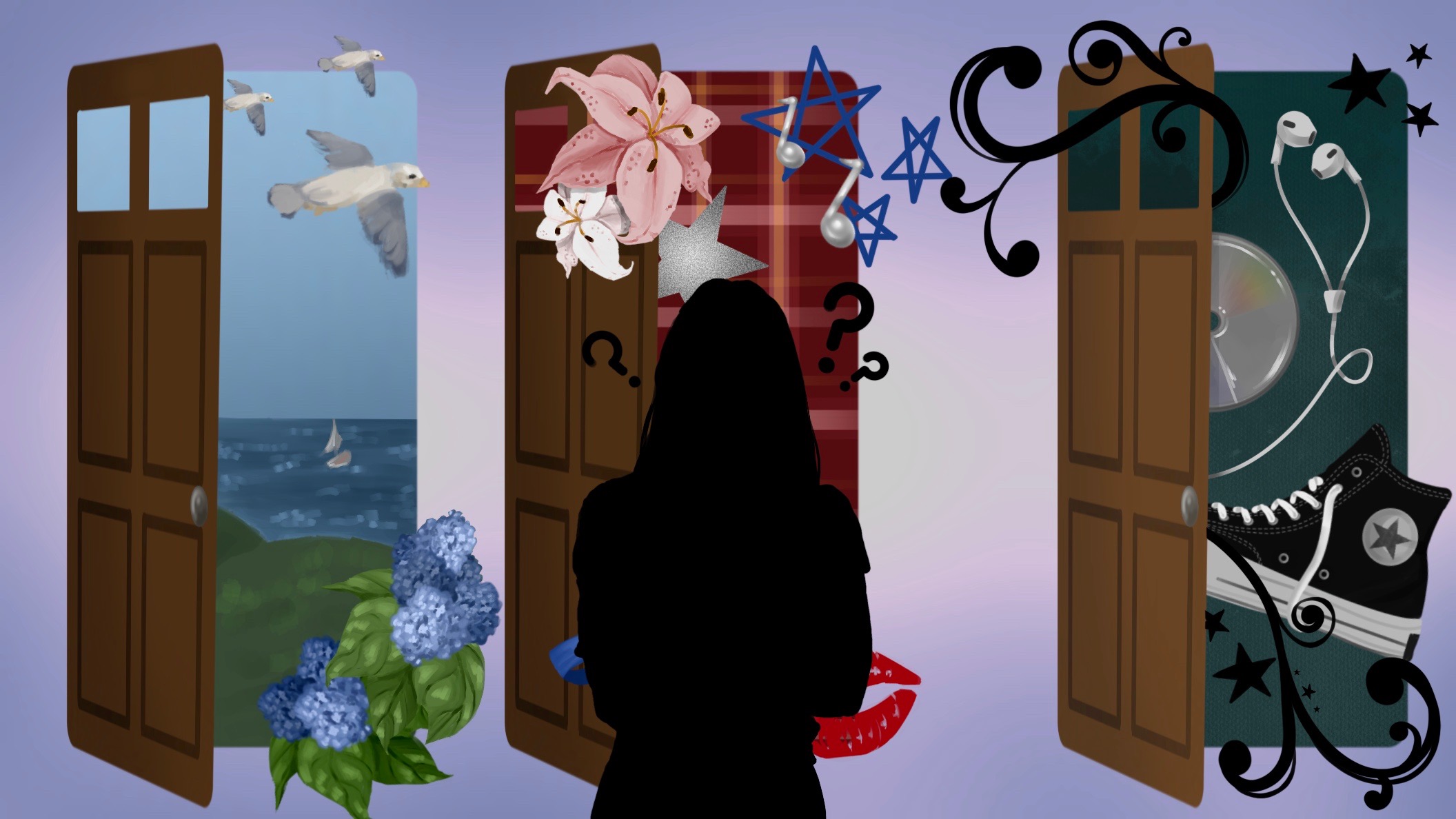
People have abandoned personal style. And social media’s to blame. From trending styles to key “must-have” pieces, the spread of styles online has deteriorated how users absorb inspiration. Online media has drastically reshaped how trends are both created and consumed, encouraging people to categorize themselves into the strict bounds of aesthetics like “grunge,” “clean girl,” “minimalist,” and “coastal granddaughter.” Some of these categories feel completely artificial—I mean, what the hell is coastal granddaughter? However, these aesthetics, though marketed as self-expression, are actually promoting conformity and adding pressure to something that is supposed to be easy by nature. They’re providing a template for something that can’t be copied. They’re rewarding familiarity over originality.
This pressure, the feeling of needing to meet requirements of some aesthetic for acceptance, is not coincidental—it is fueled through algorithms and increases the pressure on people to confine themselves to them. By pushing content that performs well and circulates rapidly, trends reach wide audiences and become instantly noticeable in school hallways.
While trend diffusion is not unique to the digital age we are currently in, the way it spreads today is fundamentally different.
Tony Bravo, Fashion Department Instructor for City College of San Francisco and writer for the San Francisco Chronicle, has noticed this new pressure from social media.
Social media makes society cycle through trends faster. Bravo nods to how speed and visibility of trends today, through social media, have changed how comfortable and quickly people swap through styles. “Our periods of retro used to be about 20 years—beginning in the 1990s when Tom Ford looked back to the 1970s at Gucci—but I would argue they are now maybe about 15 years,” Bravo said.
“Our attention span for trends becomes shorter when we see the same content repeatedly. I think social media has rewired us in all kinds of ways like that, and it has impacted people’s relationships with how they dress,” he added.
When people chronically focus on aligning with trends, their ability to discover their own style is hindered. The rapid pace of trends makes it difficult for personal style to develop, which should be an individual, gradual journey.
Additionally, algorithms tend to push out what is familiar, things people find comfort in and are willing to re-adopt. It’s always something casual: baggy jeans, claw clips, and mullets have made a comeback, even with origins predating the internet.
For students especially, these trends function as more than inspiration for an outfit; they’re something that society stresses one must conform to. As adolescent individuality is still forming, many are impressionable to the idea that they can “belong” through what they choose to wear. It feels like adopting a certain aesthetic is a decision that places you socially.
But style doesn’t come from a For You Page. Style is something unique, something personal. Its power comes from its truth: someone’s style, when not corrupted by trends, reveals deeply personal information about them.
Sex and the City’s long-time it-girl, Carrie Bradshaw, was first introduced when the show aired in 1998. Carrie is known for her maximalist style, characterized by her Fendi baguette bags, mismatched Manolos, and her tendencies for mixed patterns and bold accessories. Although her style was not a traditional blend of colors in any sense, it’s realistic, with stores like H&M and Nordstrom Rack carrying similar pieces both in the ’90s and now. Her style feels authentic and really encapsulates who she is. It’s these factors that caused Carrie’s fashion to quickly spread through the closets of many women around the world and continue to inspire those who enjoy the show.
Recently, the TV series Love Story: John F. Kennedy Jr. and Carolyn Bessette has sent off a whirlwind of Carolyn Bessette Kennedy impersonators. Complete with their vintage Levi’s and basic T-shirts, they claim to be emulating a style icon—but isn’t this just a regular outfit? Yet, there’s something about a style tied to a name that seems to intrigue the majority of those present online. By mimicking timeless fashion, composed of blue jeans and black boots, many are reflecting how standard outfits can become alluring when painted as “in.”
Look back to the outburst of “coconut girls” the world gained once Outer Banks’ Sarah Cameron took over algorithms. From puka shells to jean shorts and bikini outfits, the influence of a singular character was amplified by its social media presence in 2020.
While people have always looked to cultural figures like Carrie Bradshaw or Carolyn Bessette Kennedy for style inspiration, the media’s level of influence has completely evolved. In the ’90s and prior, trends spread through television, magazines, and word of mouth. This allowed for individual interpretation and adaptations, prompting more flair and truth. Today’s algorithm-driven platforms push categories to millions of users with more rigid boundaries, established by “must-have” items. What we once named inspiration has now become replication, no longer influenced by style icons, but now a push for conformity.
At a point, recreation of particular styles has neared what many would call a costume. Come to think of it, most people are even more creative when planning their Halloween costumes. Unequivocally mimicking someone’s style requires little thought, originality, or personal taste.
When these characters push out a new concept of style, whether flashy and new or simple and minimal, society ruins whatever makes it special. Carrie Bradshaw’s style gained traction because of her uniqueness. The flashy colors, patterns, and textures do not work the same way when all the princesses of the Upper East Side, and even the California and Nebraska girls, start wearing them too (when Carrie is obviously a downtown girl at heart). The quintessential New York City ‘it-girl’ cannot be replicated correctly if you can’t embody what works so well for the effortless city girls.
Carolyn Bessette Kennedy, on the other hand, is simple, but she somehow makes simplicity work so well—something unique to her that, when recreated, just does not work. While she embraced a minimal way of dressing, what made her pull off outfits so well is something you cannot purchase in stores: her confidence. She did not dress for others’ approval, resulting in an effortless vibe difficult to recreate.
Fashion Design Instructor for West Valley College, Anthony Murray, has gained a sense for what pushes us into new styles and trends. “Social media has disrupted the idea of what is popular. There used to be more of a shared culture before social media, the internet, and streamed content,” he said.
As we clean out our closets every now and then, we find the remains of old trends and the nostalgia they leave behind. It’s easy to look back and think, “What was I wearing five years ago?” We frame this reaction as personal growth, but it often reveals something else: how much our choices have been shaped by social media. Before this influence, people wore things simply because they wanted to.
We aren’t impressing ourselves: we aren’t consuming styles we genuinely enjoy and will long-term return to. The idea of a capsule wardrobe is continually being diluted by trending pieces that take up too much space. If we aren’t fulfilling ourselves, and we are constantly striving for new and exciting concepts, we end with one circling outcome: boredom.
“Algorithm-driven content has connected people in ways not possible before the internet. This is both positive and negative. Exposure to diverse ideas enriches us all, but the algorithm can also be isolating,” Murray said.
We’ve become so hyperfixated on a certain something, whether that be an influencer, a character, or an aesthetic, that we are ultimately reducing ourselves to followers who lack the uniqueness of personal style. People adopt things that a “cool person” does or wears, but miss the bigger reason as to why that person made those choices. To have personal style means to pick something because it’s unique to you and makes you feel like you—when mimicked, that does not translate. By hyperfixating on something that catches the eye or embodies what is in style, followers only mimic that one thing rather than the true reason the person first intrigued them. These inspirations are admirable for the sole purpose that they combine unique things together that fit them, look good on them, and genuinely excite them—not just things that are popular.
“Creativity doesn’t happen in a vacuum, one’s tastes and sense of identity are shaped by the world around us, including trends and fashion aesthetics or subcultures. Belonging and self-expression are not opposing forces, self-expression is a way of communicating to the world and connecting with others,” Murray said.